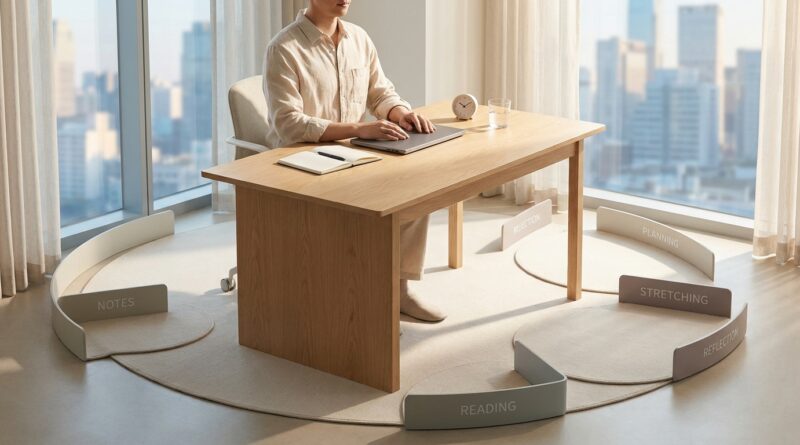
The 5‑Pillar Slow‑Hour Habit: A Minimalist Way To Turn Dead Time At Work Into Real Progress
You know that weird stretch at work when nothing urgent is on fire, but you also cannot fully relax? So you click around, check your phone, answer one email, stare at your inbox, then somehow an hour disappears. It feels small in the moment, but by the end of the day it leaves a nasty little trail of guilt. You were technically available, technically busy, and yet nothing that matters really moved forward.
That is exactly where a slow productivity routine for slow hours at work can help. Not with some intense life overhaul. Not with a color-coded planner that turns you into your own middle manager. Just a simple habit for those in-between pockets of time. Think of it as a five-part reset. You use the lull to clear your head, handle one useful task, improve one system, learn one small thing, and leave a note for your future self. Quiet progress. Real progress. No fake hustle required.
⚡ In a Hurry? Key Takeaways
- A slow productivity routine for slow hours at work turns wasted downtime into steady progress with five simple pillars.
- Start with just one slow hour a day: reset, do, improve, learn, and log what you finished.
- This works best when you stay within your job boundaries and use low-pressure time, not urgent deadlines, for the habit.
Why slow hours feel so uncomfortable
Most people do not struggle because they are lazy. They struggle because slow time at work is oddly slippery.
You are not busy enough to be locked in. But you are not free enough to switch off. So your brain picks the easiest middle ground. A little scrolling. A little tab hopping. A little fake busyness. It looks harmless, but it leaves you scattered.
This is one reason the idea of slow productivity is catching on. People are starting to see that constant motion is not the same as useful work. If anything, endless busyness often wrecks focus and drains energy.
If that sounds familiar, you may also like The 5-Pillar Slow-Stream Workday: A Minimalist Way To Do Less, Finish More, And Finally Feel Done. It fits the same idea. Less noise. Better results.
What the 5-Pillar Slow-Hour Habit actually is
The 5-Pillar Slow-Hour Habit is a minimalist script for one low-pressure hour at work. You do not need a new app. You do not need your boss to redesign your calendar. You just need a patch of time that would otherwise melt away.
Here are the five pillars:
1. Reset
Spend 5 minutes clearing mental clutter. Close random tabs. Put your phone out of reach. Take a sip of water. Write down the one thing this hour is for.
2. Do
Spend 20 to 25 minutes on one real task. Not five tiny half-tasks. One useful thing that can be finished or clearly advanced.
3. Improve
Spend 10 to 15 minutes fixing a recurring annoyance. Rename files properly. clean up a template. Organize notes. Write a better canned response. Tiny system fixes save future time.
4. Learn
Spend 10 minutes learning something small that helps your current work or future growth. Read a short article. Watch a quick tutorial. Review a process you never quite understood.
5. Log
Spend 5 minutes writing down what you did, what changed, and what the next step is. This closes the loop and makes the hour count twice, because future-you will not have to re-figure everything out.
Why this works better than “just be productive”
“Be productive” is too vague. It sounds useful, but in a slow hour it often turns into pressure without direction.
The five-pillar method works because it gives your brain a lane. You are not asking, “How do I become a better person before 3:00 PM?” You are asking, “What can I do with this one hour that will leave me better off than I was?”
That is manageable. More important, it is repeatable.
How to use a slow productivity routine for slow hours at work
Let’s make it practical.
Step 1: Spot your usual dead zones
Look for the same low-energy windows that show up most days. Maybe it is the 40 minutes before lunch. Maybe it is the gap after a recurring meeting. Maybe it is that late-afternoon dip when nobody replies quickly anyway.
Do not wait for a perfect open hour. Start with the time you already lose.
Step 2: Keep a tiny Slow-Hour list
Make a short list with three categories:
- Tasks I can finish in 20 minutes
- Systems I can improve in 10 minutes
- Skills I can learn in 10 minutes
This matters because slow hours are terrible for decision-making. If you have to invent the plan on the spot, you will probably drift.
Step 3: Protect the hour from low-value noise
You do not need monk-like silence. You just need fewer leaks.
Close social media. Mute personal notifications. Put Slack or Teams on a setting that still lets urgent messages through but cuts random chatter if your workplace allows it. If not, simply keep one window visible and shut the rest.
Step 4: Finish before you switch
The biggest mistake is turning the hour into a sampler platter. Five minutes here. Seven minutes there. Nothing lands.
Try to complete one meaningful chunk before moving to the next pillar. Progress feels better when you can point to something and say, “That is done.”
A sample slow hour, start to finish
Here is what this could look like in real life for an office worker with a 2:00 PM lull:
2:00 to 2:05 PM. Reset
Close shopping tab. Put phone face down. Write: “Use this hour to finish the client follow-up sheet.”
2:05 to 2:30 PM. Do
Complete the client follow-up sheet and send it.
2:30 to 2:42 PM. Improve
Create a cleaner template for the follow-up sheet so the next one takes less time.
2:42 to 2:52 PM. Learn
Read a short guide on spreadsheet shortcuts or better formatting.
2:52 to 3:00 PM. Log
Note what was sent, save the new template, and write the next action: “Use template for Friday batch.”
That is not glamorous. It is not hustle culture. But it is real progress from an hour that might have vanished.
What to do in each pillar if your brain feels fried
Some slow hours are not calm and fresh. Some are foggy. You are mentally cooked, but still on the clock.
That is fine. The habit still works. Just lower the difficulty.
Easy Reset ideas
- Clear your desktop
- Write one sentence: “For the next 30 minutes, I am doing this”
- Take 10 slow breaths
Easy Do ideas
- Reply to the one email you have been avoiding
- Finish one document section
- Update one task tracker honestly
Easy Improve ideas
- Delete duplicate files
- Save a reusable reply
- Clean up one folder
Easy Learn ideas
- Read one page of internal documentation
- Learn one keyboard shortcut
- Watch a 5-minute how-to video
Easy Log ideas
- Write what got done
- Write what is blocked
- Write the next smallest step
What this habit is not
It is not a trick to squeeze every drop out of yourself.
It is not a way to make workers feel bad for having normal energy dips.
And it is definitely not permission for employers to expect nonstop output from every quiet minute.
This habit is for reclaiming the overlooked parts of the day. It helps you stop bleeding attention into nothingness. That is very different from trying to become a machine.
Common mistakes that ruin the slow hour
Trying to do all five pillars perfectly
You do not need perfection. You need rhythm. If one day your “learn” pillar is only three minutes, that still counts.
Picking vague tasks
“Work on project” is too fuzzy. “Draft intro paragraph” is better. Specific tasks are easier to start.
Using the hour only for chores
Admin tasks matter, but if every slow hour goes to cleanup, you may feel organized without actually moving forward. Try to include at least one pillar that builds future value.
Forgetting to log
This is the easiest part to skip and one of the most useful. Logging gives the hour a clean ending and makes it easier to restart tomorrow.
Who this helps most
This method is especially useful for:
- Office workers with gaps between meetings
- Remote workers dealing with digital distractions
- Support, admin, and operations staff with uneven demand
- Anyone tired of looking busy instead of making progress
If your day is already chaotic from wall to wall, the habit may show up in shorter bursts. Even then, the same five pillars can work in mini form.
At a Glance: Comparison
| Feature/Aspect | Details | Verdict |
|---|---|---|
| Ease of starting | Needs no new tools, only a low-pressure hour and a simple five-step script. | Very beginner-friendly |
| Impact on real progress | Balances immediate work, small process fixes, and learning so the hour is useful now and later. | High value for small effort |
| Risk of burnout | Lower than grind-style systems because it uses existing downtime and encourages focus over constant intensity. | Sustainable if used with healthy boundaries |
Conclusion
The best part of the 5-Pillar Slow-Hour Habit is that it respects real life. It does not ask for a perfect calendar, a fancy app, or a total personality transplant. It just gives you a better script for the overlooked slices of the workday. And right now, that matters. More people are waking up to the fact that constant busyness quietly wrecks focus, health, and long-term results. At the same time, many workers still lose big chunks of low-pressure time to doom-scrolling, tab juggling, or looking busy. A slow productivity routine for slow hours at work gives you a practical middle path. One hour. Five simple pillars. A boring lull turns into genuine progress on what matters. That is not small. Over a week or a month, it can change how your whole workday feels, and what you actually get done.