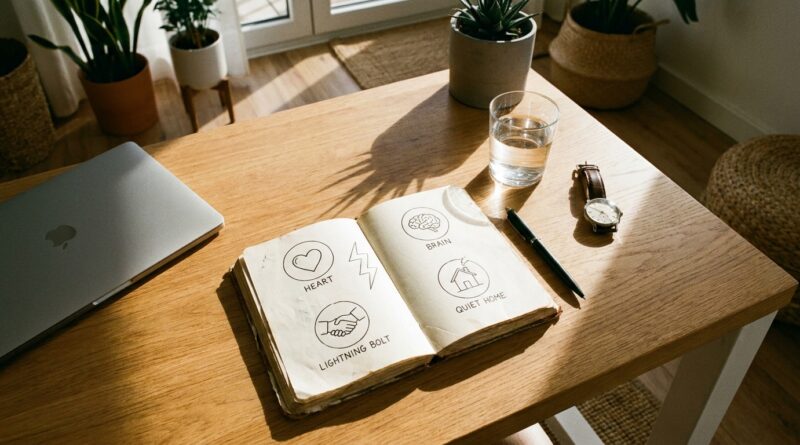
The 5‑Pillar Intentional‑Living Workday: A Minimalist Way To Make Every Hour Match Your Values
You can have a packed calendar, a tidy task app and a strong work ethic, then still end the day with a weird, sinking feeling. You got things done. Maybe a lot of things. But not the things that make your life feel like yours. That is the real problem behind so much modern productivity advice. It helps you move faster, but not always in the right direction. If that sounds uncomfortably familiar, you do not need a total life reset. You need a simpler filter. A small one. The 5-Pillar Intentional-Living Workday is a minimalist productivity routine built to help each hour match your values, not just your inbox. No new app. No color-coded life dashboard. Just five practical checks you can use to shape your day before your day shapes you. The goal is not perfection. It is to stop winning at tasks while quietly losing the plot.
⚡ In a Hurry? Key Takeaways
- The best intentional living minimalist productivity routine starts by matching your calendar to five clear values-based pillars, not by adding more tools.
- Pick five daily pillars, choose one must-do action for each, and use them to guide what you accept, delay or ignore.
- If a routine makes you feel more managed but less human, it is too complicated. Keep it light enough to actually use every morning.
Why productivity alone is not enough
A lot of people are not struggling because they are lazy. They are struggling because they are efficient in too many directions at once.
Your phone buzzes. Your team pings. A new AI tool promises to save time. Another app offers better focus. Before long, your day is full of motion but thin on meaning. You are responsive, busy and dependable. You are also tired, distracted and not fully sure why the workday keeps eating the parts of life you care about most.
That is where intentional living helps. Not the glossy, perfect version. The useful version. The kind that asks one honest question: does the way I spend my time match what I say matters?
If the answer is often no, you need a workday structure that is small enough to use and strong enough to keep you honest.
What the 5 pillars actually are
Think of the five pillars as five buckets your day should support. They are not fixed for everyone. They should reflect your values, not somebody else’s morning routine on YouTube.
A simple set might look like this:
- Health. Energy, sleep, movement, food, breaks.
- Relationships. Family, friends, partner, coworkers you want to treat like people.
- Meaningful Work. The work that truly matters, not just busywork.
- Growth. Learning, reflection, skill-building, faith, reading, thinking.
- Maintenance. Admin, chores, bills, email, logistics, the boring but real stuff.
Your version may be different. Maybe creativity belongs there. Maybe service. Maybe recovery. The point is to choose five that are easy to remember without checking a note.
Why five works
One or two categories are too broad. Ten is too many. Five is enough to hold a full life in view without turning your routine into homework.
How to build your intentional living minimalist productivity routine
Step 1: Name your five pillars in plain language
Skip abstract labels that sound nice but mean nothing at 8:15 on a Tuesday.
“Wellbeing” is fine if it means something clear to you. But “Move my body and protect my sleep” is better. “Connection” is okay. “Be present with my family” is better.
If a pillar is fuzzy, it will not guide your choices.
Step 2: Give each pillar one daily proof
This is where most good intentions fall apart. Values feel real only when they show up on the calendar or the checklist.
For each pillar, ask: what is one small action that proves this matters today?
- Health: Walk for 20 minutes after lunch.
- Relationships: Have dinner with phone off the table.
- Meaningful Work: Spend 60 minutes on the project that actually moves things forward.
- Growth: Read 10 pages or review notes for 15 minutes.
- Maintenance: Clear one admin task you have been avoiding.
Not a full transformation. Just proof.
Step 3: Build your day around the big block first
The most important pillar for most workdays is usually meaningful work, because it is the one most likely to get buried under messages and small requests.
Start by blocking time for the one task that matters most. Put it early if you can. Protect it like a meeting.
Then place the smaller proofs for the other pillars around it.
This is minimalist on purpose. You are not filling every minute. You are making sure your top values get a seat before noise takes all the chairs.
Step 4: Use the pillars as a decision filter
Here is where the framework really earns its keep.
When a request lands, ask:
- Does this support one of my pillars?
- Is it urgent, or just loud?
- If I say yes to this, which pillar loses time?
That last question is the one most people skip. Every yes comes from somewhere. Usually from sleep, focus, calm or the people waiting for the best version of you at home.
Step 5: End the day with a two-minute check
Do not do a dramatic life review. Just check the five pillars.
Which ones got attention? Which one got ignored? What needs help tomorrow?
This quick reset stops one bad day from becoming one bad month.
A sample workday using the five pillars
Here is what this can look like in real life:
Before work, 5 minutes: Review your five pillars. Write one proof for each.
First work block, 60 to 90 minutes: Do the meaningful work task before opening chat or email fully.
Mid-morning: Handle maintenance tasks in a batch instead of all day long.
Lunch: Eat away from the screen, then take a short walk for the health pillar.
Afternoon: One meeting block, one lighter admin block, one short growth block if possible.
Evening: Phone down during dinner or a check-in call with someone you care about.
Before bed, 2 minutes: Score the day quickly. Did your hours reflect your values more than yesterday?
That is it. Not fancy. Effective.
What usually goes wrong
You turn the pillars into another performance system
If you start tracking 37 habits, measuring every hour and feeling guilty when one pillar has a quiet day, you have rebuilt the same problem in a prettier form.
The pillars are guides. Not a morality test.
You confuse maintenance with meaningful work
Email, scheduling and follow-ups can eat the entire day while giving you the pleasant illusion of progress. Maintenance matters. It just cannot be the star of every day.
You keep your environment noisy
It is hard to live intentionally in a house or workspace that interrupts you every six minutes. If your devices constantly compete for your attention, it helps to calm the space around you too. That is where The 5‑Pillar Quiet-Tech Home: A Minimalist Way To Tame Smart Devices Without Killing Your Productivity fits nicely. A quieter tech setup makes a values-based workday much easier to protect.
How this helps when AI and apps are everywhere
Right now, many people are not short on options. They are drowning in them.
Every week brings a new assistant, new planner, new automation trick, new system for fixing your life. Some of them are useful. But tools are not the same as direction.
The five-pillar method gives you direction first.
Then, if you use tools, you use them on purpose. AI can help draft an email, summarize notes or reduce low-value busywork. Great. But it should support a pillar, not create more digital clutter dressed up as progress.
A good test is simple. If a tool saves time but that time immediately gets swallowed by more noise, it is not helping your life much.
How to start tomorrow morning
You do not need a new notebook. You do not need to rebuild your calendar from scratch. Start with this:
- Write down your five pillars on paper.
- Add one proof for each pillar for tomorrow.
- Block one focused session for meaningful work.
- Silence or move the noisiest notifications during that block.
- At the end of the day, review the five pillars in two minutes.
Run that for a week before changing anything else.
You will learn more from one week of honest use than from three hours of reading about perfect routines.
At a Glance: Comparison
| Feature/Aspect | Details | Verdict |
|---|---|---|
| Traditional productivity system | Optimizes tasks, deadlines and efficiency, but may ignore whether the work matches your real priorities. | Useful, but incomplete on its own. |
| 5-pillar intentional routine | Uses five values-based pillars to decide what deserves time each day, with one small proof per pillar. | Best for aligning action with what matters. |
| App-heavy life redesign | Adds more dashboards, reminders and complexity, often creating another layer of maintenance. | Usually too much if your goal is clarity. |
Conclusion
It makes sense that intentional living is catching fire across podcasts, blogs and Reddit threads. People are starting to see that basic productivity tips are not enough when the work itself feels off. If your days feel crowded by AI tools, notifications and endless choices, the missing piece is often not another system. It is a short list of values you can name without thinking, then use to shape the next hour. That is why a five-pillar framework works so well. It turns vague good intentions into a minimalist productivity routine you can actually run tomorrow morning, with what you already have. No shopping. No app spree. No dramatic reinvention. Just a calmer, clearer way to make sure your workday reflects your life, instead of replacing it.