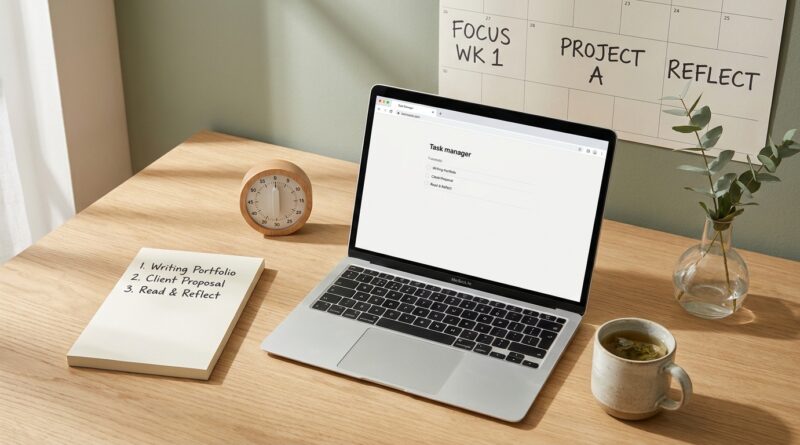
The 5-Pillar Slow-Stream Workday: A Minimalist Way To Do Less, Finish More, And Finally Feel Done
You are not lazy. You are overloaded. That is the real problem. Too many people are trying to push 15 half-open projects forward while email, chat, and calendar alerts peck at them all day. By 5 p.m., they have been busy for hours and still feel strangely unfinished. It is like living inside a browser with 47 tabs open and no clue which one started the music. A slow productivity minimalist workday is not about doing less because you have given up. It is about cutting the noise so the work that matters can actually get done. The goal is simple. Fewer active projects. Clearer focus blocks. Smaller daily targets. More moments where you can honestly say, “That is done.” This five-pillar setup is a practical way to make your workday feel human again, without a fancy app, a color-coded wall planner, or a dramatic life reset.
⚡ In a Hurry? Key Takeaways
- A slow productivity minimalist workday works best when you limit active work, protect focus time, and define what “done” means before the day starts.
- Start with just three daily priorities, one or two focus blocks, and set times for checking email instead of reacting all day.
- You do not need a new tool or full routine makeover. This works with your current calendar, notebook, or to-do list.
Why the usual productivity advice stops working
Most productivity systems fail for a boring reason. They ask your brain to keep track of too many moving parts at once.
That looks efficient on paper. In real life, it feels awful.
You answer messages while thinking about a report. You join a meeting while worrying about two overdue tasks. You switch from one half-done thing to the next and tell yourself you are multitasking. But your brain pays a tax every time it switches gears. By midday, you are tired and oddly annoyed, even if nothing dramatic has happened.
Slow productivity is the correction. It says your workday should have shape, limits, and breathing room. It should not feel like an emergency room with better lighting.
The 5-Pillar Slow-Stream Workday
This method is minimalist on purpose. It gives you five simple pillars to build a calmer day around. Not a perfect day. A usable one.
1. Cap your active projects
If everything is in progress, nothing is really moving.
The first pillar is to limit how many meaningful projects you are actively pushing at one time. For most people, that number is three. Maybe five if your role is unusually broad. But 12 or 15 active projects usually means 12 or 15 stalled ones with slightly different due dates.
Try this. Make one list of everything on your plate. Then mark only the projects that are truly active this week. The rest are not cancelled. They are simply parked.
This is the same kind of relief people feel when they simplify other parts of life. If you liked the idea of reducing decision fatigue in your closet, you will probably enjoy The 5‑Pillar Capsule Routine: A Minimalist Way To Streamline Your Life With One Daily Uniform. The logic is similar. Fewer live choices often means more calm and better follow-through.
2. Choose three wins for the day
A long task list creates guilt faster than momentum.
The second pillar is to pick three meaningful wins for today. Not 17. Three.
These should be outcomes, not vague intentions. “Finish the first draft of the client summary” beats “work on client stuff.” “Send the budget for approval” beats “look at budget.”
This changes your workday from open-ended struggle to a finite game. It also gives your brain a stopping point. That matters more than people think.
If more than three things matter, group the rest into admin, maintenance, or later. Your list can still exist. It just should not run your mood.
3. Protect two real focus blocks
Most people do not need eight hours of perfect concentration. They need two honest chunks of it.
The third pillar is to block off one or two sessions of focused work each day. Think 45 to 90 minutes. During that time, close inbox, mute chat, silence your phone, and work one problem at a time.
This is where actual progress happens. Not in the cracks between notifications.
If your workplace is noisy, start small. Even one protected 45-minute block can change the tone of the day. Put it on your calendar if needed. Treat it like a meeting with your most important project, because that is exactly what it is.
4. Batch the shallow stuff
Email is not work. It is mostly other people assigning work.
The fourth pillar is to batch reactive tasks into set windows. Check email at 11 a.m. and 4 p.m. Process chat after your focus block. Group approvals, scheduling, and quick replies together.
This reduces the constant mental restart that makes days feel long and slippery.
You do not have to become unreachable. You just need a rhythm. If someone truly needs you urgently, they will usually find a way beyond “sent from my iPhone.” For everyone else, a few hours is normal.
5. End with a shutdown ritual
The reason work follows people into the evening is often simple. The day never got a proper ending.
The fifth pillar is a short shutdown ritual. Ten minutes is enough.
Before you log off, do three things:
1. Note what you finished.
2. Decide the first task for tomorrow.
3. Park loose thoughts somewhere trusted.
This tells your brain that work has been contained. It lowers that nagging “I am forgetting something” feeling that can ruin dinner, a walk, or sleep.
What a slow productivity minimalist workday actually looks like
Here is a simple example.
Morning
Review your three wins. Start your first focus block before opening inbox if possible. Use your best energy on your hardest task.
Midday
Check email once. Handle admin in a batch. Take a real break. Not a break where you scroll while half-reading Slack.
Afternoon
Run a second focus block if your day allows it. Then do meetings, approvals, follow-ups, and messages in a cluster.
End of day
Write tomorrow’s first step. Clean up your notes. Close the loop.
That is it. Not glamorous. Very effective.
How to start if your job feels too chaotic for this
A lot of readers will think, “Nice idea, but my job is pure interruption.” Fair point.
So do not force the full system on day one.
Start with the pillar that will buy you the most relief fastest.
If meetings eat your day
Protect one 30-minute focus block before the first meeting.
If email runs your life
Move to two or three inbox checks instead of constant grazing.
If everything feels urgent
Cap your active projects and ask, “Which three really move this week forward?”
If you never feel done
Add the shutdown ritual tonight.
The point is progress, not purity. A minimalist workday is meant to reduce friction, not become one more thing to fail at.
Common mistakes that make this harder
Confusing visible busyness with useful work
Fast replies and a packed calendar can look productive while your important work sits untouched.
Using your to-do list as storage for anxiety
If your list has 47 items, it is probably collecting worries, not priorities.
Leaving tasks undefined
“Work on presentation” is too fuzzy. “Write slide 1 to 5” gives your brain a finish line.
Never deciding what can wait
Minimalism at work is not only choosing what to do. It is choosing what not to push today.
At a Glance: Comparison
| Feature/Aspect | Details | Verdict |
|---|---|---|
| Traditional hustle workday | Many active projects, constant inbox checking, frequent context switching, vague end point | Feels busy, often ends in burnout and half-finished work |
| Slow productivity minimalist workday | Capped projects, three daily wins, protected focus blocks, batched admin, shutdown ritual | More sustainable and more likely to produce completed work |
| Best way to begin | Adopt one pillar first, usually focus blocks or inbox batching, then build from there | Low stress, easy to test, no new app required |
Conclusion
The big shift right now is not squeezing more output from every hour. It is getting back to fewer, deeper wins that actually finish. That is why slow productivity, smaller workloads, and protected focus time are catching on. People are tired of systems that ask them to run faster while feeling worse. The good news is you do not need a dramatic overhaul to fix your day. This five-pillar template gives you a calmer path. Limit active projects. Pick three wins. Protect focus. Batch the shallow stuff. End the day on purpose. Done consistently, that is how work starts to feel manageable again. Not perfect. Not magic. Just lighter, clearer, and a lot more satisfying.