The 5-Pillar Quiet-First Workspace: A Minimalist Way To Turn Noise Overwhelm Into Deep Focus
You are probably tired of being told to wake up earlier, time-block harder, or download one more focus app. That advice can feel almost insulting when the real problem is obvious. Your space is loud, busy, and constantly interrupting you. Maybe it is an open office where every phone call becomes your business. Maybe it is a kitchen table with kids, traffic, and package deliveries in the background. Maybe it is your laptop pinging like a slot machine. Whatever version you are dealing with, the result is the same. Your brain never gets to settle. If you want a real minimalist workspace for deep work, start by treating noise and visual chaos as design problems, not personal failures. A quiet-first workspace is not fancy. It is simply a setup that protects your attention before you have to fight for it.
⚡ In a Hurry? Key Takeaways
- A minimalist workspace for deep work starts with reducing noise, visual clutter, and digital interruptions, not with buying more tools.
- Use a simple five-pillar setup: sound control, visual calm, digital silence, physical comfort, and clear work boundaries.
- You do not need a full home office or expensive gear. Small changes to your current room can improve focus fast.
Why focus feels harder than it should
Most people blame themselves when they cannot concentrate. They assume they are lazy, undisciplined, or bad at modern work. Usually, that is not true.
Your brain reacts to what is around it. Noise, movement, clutter, alerts, and half-finished tasks all compete for attention. Even if you do not fully notice them, your nervous system does. That is why shallow work feels easy and deep work feels out of reach.
There is a growing shift in how people think about productivity. The old model said, “Try harder.” The better model says, “Fix the room.” If your environment keeps pulling you out of focus every two minutes, no routine can fully save you.
If this sounds familiar, you may also like The 5‑Pillar Attention Hygiene Day: A Minimalist Way To Stop Leaking Focus In A Noisy World. It pairs well with workspace changes because attention leaks do not just come from habits. They come from surroundings too.
The 5 pillars of a quiet-first workspace
1. Sound control
Noise is usually the first thing that breaks deep work. Speech is especially disruptive because your brain tries to process it, even when you do not want to listen.
You do not need a soundproof office. You need less unpredictable noise.
Start with the basics:
- Face away from high-traffic areas if possible.
- Close a door, even partway, if you have one.
- Use soft items like curtains, rugs, cushions, or a fabric wall hanging to absorb echo.
- Try earplugs, simple over-ear headphones, or low-volume white noise.
- Block specific noisy times for admin work, and save quiet windows for deep work.
If you work in an open office, the goal is not perfect silence. It is making the soundscape more steady and less intrusive.
2. Visual calm
A cluttered desk is not just ugly. It keeps sending your brain little reminders. Bills. Cables. Sticky notes. Random gadgets. Open tabs on paper.
Minimalism helps because it lowers the number of things asking for your attention.
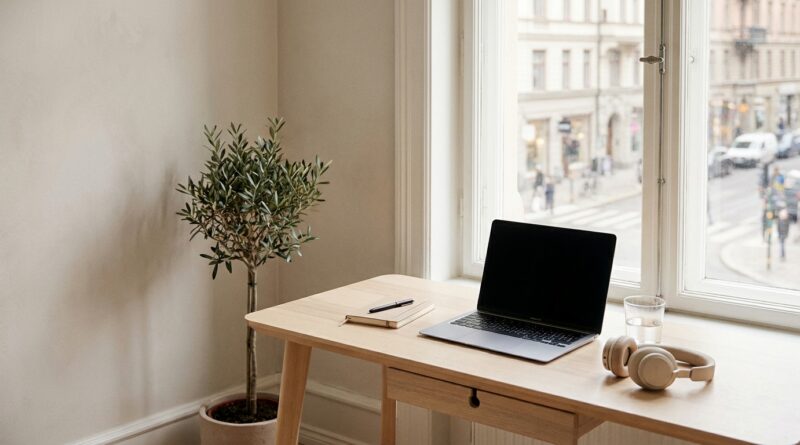
Try this desk rule. Keep only what supports the task you are doing right now. That might be your laptop, a notebook, water, and one reference document. Everything else can move off the work surface.
This matters more than people think. A clean visual field helps your mind stop scanning and start settling.
3. Digital silence
A quiet room is not enough if your devices are noisy. For many people, the loudest part of the workspace is the screen.
Notifications create the same scattered feeling as background chatter. You may not answer every ping, but each one leaves a mental mark.
Build a default “deep work mode” on your devices:
- Turn off non-human notifications. Apps do not need your instant attention.
- Use Do Not Disturb during focus blocks.
- Hide the dock or taskbar badges if they pull your eyes away.
- Keep only the tabs and apps needed for the current job.
- Put your phone out of reach, ideally behind you or in another room.
This is where many productivity systems fall apart. They add more layers without stopping the interruptions that break concentration in the first place.
4. Physical comfort
Discomfort is a sneaky distraction. If your chair hurts, your screen is too bright, or your room is too hot, your attention keeps drifting back to your body.
You do not need an influencer-grade office makeover. You need a setup you can forget about for an hour at a time.
Check these first:
- Can you sit with your shoulders relaxed?
- Is the screen high enough that you are not craning your neck?
- Is there glare on the display?
- Do you have decent light on your face and desk?
- Can you keep water nearby so you are not constantly getting up?
Comfort supports focus because it removes one more stream of low-level friction.
5. Clear work boundaries
This pillar is the least physical and maybe the most important. A quiet-first workspace needs signals. You need cues that tell your brain, and ideally the people around you, what mode you are in.
Boundaries can be simple:
- A lamp turned on only during deep work.
- Headphones that mean “please do not interrupt unless it is urgent.”
- A small sign on a door.
- A set work mat or tray that comes out only for focused tasks.
- A recurring focus block on your calendar that others can see.
These little rituals matter. They reduce decision fatigue and make deep work feel like entering a protected zone instead of hoping for lucky silence.
How to build a minimalist workspace for deep work without spending much
The best part of this approach is that it is not gear-heavy. You can improve your setup with what you already have.
Start with a 20-minute reset
Set a timer. Clear your desk completely. Put back only the essentials for your most important type of work. Then look around and remove one source of noise, one source of clutter, and one digital interruption.
That alone can change how the room feels.
Pick one “focus corner”
If you cannot have a whole office, claim a consistent spot. A specific chair, end of the table, or corner of a room can become your focus zone. Consistency helps your brain switch modes faster.
Use time to your advantage
Some environments will never be quiet all day. That is fine. Build your deep work around the quietest 60 to 90 minutes available, then defend that time.
Quiet-first does not mean silence at all costs. It means making your best work happen when conditions are best.
What to do in open offices and shared homes
These are the hardest environments, and they are also the most common.
In open offices
- Book small rooms for your hardest thinking work when you can.
- Sit at the edge of activity, not in the center of it.
- Batch collaborative tasks together so interruptions happen in one window.
- Use headphones and a visible focus cue.
In shared homes
- Talk with the people around you about one or two protected time blocks.
- Use background sound to soften sudden household noise.
- Store work tools in a box or basket so you can set up and pack down fast.
- Choose the least interrupted area, even if it is not the prettiest.
This is a big mindset shift. The goal is not a perfect Pinterest office. The goal is a functional environment that asks less from your brain.
Common mistakes people make
A lot of focus advice misses the mark because it assumes more systems will solve everything. Usually, people make one of these mistakes:
- They buy new apps before removing old distractions.
- They organize supplies but ignore sound.
- They chase aesthetics instead of usability.
- They expect self-control to beat constant interruption.
- They change routines weekly instead of stabilizing the environment.
A quiet-first workspace is simpler than that. Remove what pokes at your attention. Keep what supports the work.
At a Glance: Comparison
| Feature/Aspect | Details | Verdict |
|---|---|---|
| Noise management | Soft materials, headphones, white noise, and better desk placement reduce surprise interruptions. | High impact, low cost |
| Desk minimalism | Keeping only current-task items visible cuts visual distraction and mental clutter. | Easy win for most people |
| Digital boundaries | Do Not Disturb, fewer tabs, and moving the phone away stop attention from fragmenting. | Essential for real deep work |
Conclusion
You do not need to become a productivity machine. You need a room, or even just a corner, that stops fighting your brain. People are worn out from endlessly tuning calendars while ignoring the space where work actually happens. The direction is pretty clear now. Research, work culture, and office design all point to the same idea. Environment beats willpower more often than we like to admit. A low-stimulation, quiet-first setup is quickly becoming the simplest performance upgrade around. If you use these five pillars, you can build a minimalist workspace for deep work with small changes, not a giant life overhaul. Better focus may be closer than you think. It might start with moving a chair, muting a phone, and clearing one desk.