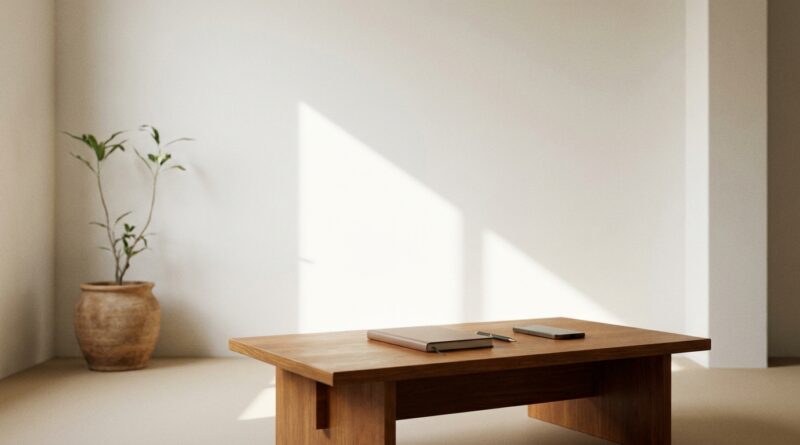
The 5-Pillar Ma Day: A Minimalist Way To Use Empty Space To Get Your Time Back
You are not lazy, disorganized or bad at productivity. You are probably just full. Full calendar. Full desk. Full phone. Full head. That is why every new app, planner method or morning routine feels exciting for about three days, then somehow leaves you just as rushed as before. The missing piece is often empty space. Not wasted time. Useful space. The Japanese idea of ma is a good way to think about it. Ma means the meaningful gap, the pause, the open area that lets everything else make sense. If your day has no gap in it, you do not get to think. You only react. If your room has no open surface, your brain keeps reading clutter as unfinished business. If your phone has no quiet corner, every spare second gets swallowed. Here is a simple five-pillar way to use ma in everyday life, without rebuilding your whole routine.
⚡ In a Hurry? Key Takeaways
- How to use Japanese minimalism ma for productivity: add intentional empty space to your schedule, room and phone so you can think before you react.
- Start small. Leave 10 minutes between meetings, clear one surface, and keep one blank note for daily thinking.
- This is not about doing less forever. It is about creating enough breathing room to do the right things with less stress.
What ma actually means, in normal-person language
Ma is often described as the space between things. A pause in music. Empty space in a room. Silence in a conversation. The gap is not a flaw. It is part of the design.
That same idea works beautifully for modern life. Productivity usually gets sold as tighter systems, faster tools and more efficient packing of the day. Ma points the other way. It says some emptiness is useful. Necessary, even.
If you want a practical answer to how to use Japanese minimalism ma for productivity, it is this: stop treating every open inch of time, space and attention as something that must be filled.
The 5-Pillar Ma Day
You do not need to move to a cabin, throw out half your stuff or quit group chats. You just need five small places where emptiness can do some work for you.
1. Calendar ma: Leave gaps on purpose
This is the big one. Most people lose their day before lunch because the calendar has no breathing room in it. One meeting runs over. A message comes in. You need five minutes to reset. There is nowhere for that time to come from, so the whole day starts sliding.
Try this instead:
- Leave 10 minutes before every meeting if you can.
- Protect one 20-minute gap in the morning and one in the afternoon.
- Do not auto-fill every blank slot with “quick tasks.”
Those gaps are not empty in a useless way. They are where you think, stretch, reply with care, and decide what actually matters next.
If your schedule is controlled by other people, start tiny. Even a three-minute pause before joining the next call counts. Close the tab. Breathe. Ask, “What does this next block need from me?” That question alone can save an hour of scattered effort.
2. Visual ma: Clear one surface
You do not need a perfect minimalist home. You need one spot that does not shout at you.
Pick a single visual zone:
- your bedside table
- one corner of the kitchen counter
- the middle of your desk
Clear it. Leave some open space visible. That is your visual ma.
This works because clutter is not just physical. It is mental prompting. Every cable, receipt, mug and unopened post-it note asks for a tiny piece of attention. One calm surface gives your eyes somewhere to land, which helps your brain stop scanning for the next problem.
If you want a simple rule, remove everything from that surface, then put back only what you use there daily. Stop before it looks “full enough.” The point is the gap.
3. Digital ma: Create one quiet screen on your phone
Your phone is probably where your empty moments go to die.
Most home screens are built like convenience stores. Bright. Busy. Full of little prompts to buy, click, check and compare. That means every micro-break becomes more input instead of actual rest.
Give yourself one quiet screen:
- Move noisy apps off the first page.
- Keep only essentials like phone, maps, messages and camera visible.
- Use a plain wallpaper.
- Turn off non-human notifications you do not truly need.
Now when you unlock your phone, you hit less visual pressure. That is digital ma.
You can go one step further and create a blank note called “Think here first.” Before opening social apps, write one line about what you meant to do. It sounds almost too simple, but it interrupts autopilot, which is exactly the point.
4. Task ma: Leave room in your to-do list
The classic to-do list mistake is pretending you can do 14 things in one day just because they fit on a page.
Ma says leave room. Not every hour needs an assignment.
Try the rule of three:
- Pick 1 must-do task.
- Pick 2 useful-but-flexible tasks.
- Leave the rest parked somewhere else.
This is not lowering your standards. It is matching the list to reality. Days have interruptions. Brains have limits. Energy moves around.
When your list has some open space, you stop getting that defeated feeling at 4 p.m. when half the page is untouched. Instead, you finish what matters and still have enough mental room to handle surprises.
5. Mind ma: Keep a blank page for thinking
Most people do not need more captured tasks. They need one place to hear their own thoughts.
Open your notes app, or use paper if you prefer. Keep one page blank except for the date and one prompt:
What is making today feel crowded?
Spend two minutes answering it.
This is mind ma. A tiny pause where you stop consuming and start noticing. Often the problem becomes obvious fast. Maybe you said yes to too much. Maybe your desk is bugging you. Maybe one email is taking up 40 percent of your mental bandwidth.
Once you can name the pressure, you can usually reduce it.
How to try the 5-Pillar Ma Day in the next 24 hours
Do not turn this into another grand life project. That would miss the point.
Try this one-day version:
- Leave one 10-minute gap before a meeting.
- Clear one visible surface.
- Remove five distracting apps from your first phone screen.
- Cut your daily list down to three priorities.
- Write on one blank page for two minutes tonight.
That is enough to feel the shift. Usually the first thing people notice is not “I became more productive.” It is “I feel less chased.” That matters. A calmer day is often a smarter day.
What ma is not
It is not doing nothing all day. It is not being passive. It is not making your home look like a showroom. And it is definitely not another purity contest where you feel guilty for having too many icons on your phone.
Ma is functional emptiness. Space with a job.
The gap before a meeting helps you show up better. The clear patch on your desk helps you focus. The blank note helps you think instead of scroll. It is minimalist, yes, but in a very practical way.
Why this works better than another “perfect system”
Many productivity systems fail because they assume your day is a machine that can be tuned forever. Real life is messier than that. Kids get sick. Calls run late. Energy dips. Someone needs you right now.
A rigid system cracks under that pressure. Space bends.
That is why ma feels so useful at the moment. People are tired of squeezing harder. They want methods that make life feel livable again. Japanese minimalist ideas like ma and kanso are getting attention for exactly that reason. They cut through burnout without demanding a complete personality transplant.
At a Glance: Comparison
| Feature/Aspect | Details | Verdict |
|---|---|---|
| Calendar space | Adds small gaps between meetings and tasks so your day can absorb real life. | High impact, easiest place to start. |
| Physical space | One clear surface reduces visual noise and lowers that constant “I should deal with this” feeling. | Simple and surprisingly calming. |
| Digital space | A quieter home screen and fewer alerts stop your phone from eating every spare second. | Best for reducing mindless distraction fast. |
Conclusion
There is a real pushback happening against the idea that productivity means cramming more into smaller blocks. Good. Most people do not need a tighter grip on the day. They need a little room inside it. That is where ma helps. It gives you a practical way to use empty space in your calendar, your room and your phone so life feels less jammed without a huge reset. Start small. Claim a micro-gap before a meeting. Clear one surface. Put one blank page in your notes app. You can feel the difference within 24 hours, and that is the beauty of it. Small, elegant moves beat complicated systems more often than we like to admit.