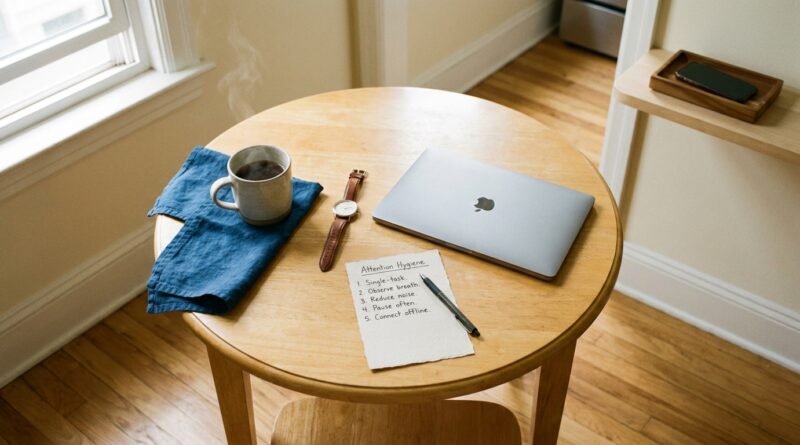
The 5‑Pillar Attention Hygiene Day: A Minimalist Way To Stop Leaking Focus In A Noisy World
You are probably not failing at focus. Your focus is being picked off in tiny pieces all day long. A notification here. An unread badge there. A quick tab switch that turns into 20 minutes of drift. By dinner, your brain feels busy and weirdly empty at the same time. That is not a character flaw. It is what happens when your attention never gets a chance to settle.
The good news is you do not need a new app, a color-coded life system, or a monk-like morning routine. You need cleaner conditions for thinking. That is where a simple attention hygiene minimalist productivity approach helps. Think of it like brushing your teeth, but for your mind. A 5-pillar Attention Hygiene Day gives you a small structure you can repeat with the tools you already own. It is less about squeezing out more output and more about stopping the daily leaks that make everything feel harder than it should.
⚡ In a Hurry? Key Takeaways
- A 5-pillar Attention Hygiene Day helps you protect focus by reducing inputs, not by adding more productivity rules.
- Start with five basics: quiet your morning, batch messages, shrink tab clutter, create one real focus block, and close the day with a reset.
- This works best when it stays minimal. If the system itself feels tiring, simplify it further.
What “attention hygiene” really means
We already understand physical hygiene. You wash up, clean surfaces, and deal with the little things before they become bigger problems. Attention works the same way.
Attention hygiene is the set of small habits that keeps mental noise from piling up. It is not about becoming perfectly disciplined. It is about making your day less interruptible.
That matters because most people are not drowning in work alone. They are drowning in access. Everything can reach you, all the time. Your phone, email, chat apps, browser tabs, calendar alerts, smart speakers, watches. Even a “helpful” app reminder can snap your brain out of a good thought.
If you have been trying to fix this with endless task managers, you may have noticed the problem is not always the list. It is the constant invasion around the list.
The 5 pillars of an Attention Hygiene Day
1. Protect the first 30 minutes
Your morning attention is expensive. Spend it on yourself first.
For the first 30 minutes after waking up, do not open email, social apps, news, or group chats. If that sounds dramatic, try it once and notice how different your brain feels by 9 a.m.
You can still use your phone for practical things. Turn off the alarm. Check the weather. Start a podcast if that helps. But avoid anything that invites reaction. The point is to stop other people’s priorities from becoming your opening scene.
Good replacements for that first half hour:
- Write down the one thing that would make today feel solid
- Drink water and stand near sunlight
- Review your calendar without opening inboxes
- Read a page of something calming instead of scrolling
This one shift alone can lower that jittery, already-behind feeling.
2. Batch your inputs instead of grazing on them
Most inbox stress comes from frequency, not volume. Looking at messages every six minutes trains your brain to live in permanent readiness.
Try message windows instead. For example:
- 11:00 a.m. for email and chat
- 2:30 p.m. for follow-ups
- 4:30 p.m. for anything urgent before close
If your job requires faster replies, shorten the gap. The principle still holds. You want designated checkpoints, not constant nibbling.
And yes, tell people if needed. A simple status message works: “Heads down this morning. I check messages at 11.” Most reasonable people accept this faster than we imagine.
The hidden benefit is emotional. Each check-in becomes a contained event instead of a low-grade all-day hum.
3. Make your screen boring on purpose
Modern devices are built to wave at you. Red dots. Animations. Suggested content. Little numbers begging to be cleared. Your brain notices all of it, even when you think it does not.
A minimalist screen is not about aesthetics. It is about fewer mental hooks.
Try this quick cleanup:
- Turn off all non-human notifications. Shopping apps, game alerts, “memories,” suggested posts. Gone.
- Keep only essential people-facing alerts, like calls from family or work-critical messages.
- Use grayscale on your phone during work hours if bright icons pull you in.
- Remove social apps from the home screen. Search for them when you truly want them.
- Close tabs aggressively. If you need to save something, bookmark it. Do not keep 27 tabs open as a form of memory.
That last one is bigger than it sounds. Tabs are not neutral. Each one is a tiny open loop whispering, “Do not forget me.” If your browser looks like a crowded airport departures board, your brain feels that load.
4. Build one defended focus block
You do not need eight perfect hours of deep work. Most people need one real block. Defended. Named. Protected.
Start with 45 to 90 minutes. Put it on your calendar. During that time:
- Phone face down or in another room
- Email closed
- Chat muted
- Only the documents needed for the task stay open
Choose one target. Not “work on project.” Try “finish outline,” “review contract,” or “draft first 500 words.” Your brain handles concrete aims better than vague ones.
If you struggle to start, make the first five minutes tiny. Open the file. Rename it. Write the ugly first line. Momentum is often quieter than motivation.
This is where attention hygiene minimalist productivity becomes practical. You are not asking yourself to become a different person. You are creating a short stretch where your mind can finally hold one shape.
5. End the day with a shutdown ritual
Attention leaks at night too. A lot of people stop working physically but never stop working mentally.
A five-minute shutdown can fix that. Before you step away:
- Write down what is unfinished
- Choose the first task for tomorrow
- Close tabs you do not need
- Clear the desktop or workspace just enough to reduce visual noise
- Silence nonessential notifications for the evening
This tells your brain, “Nothing important needs to be held in active memory now.” That matters more than people think. A good shutdown is not just organizational. It is nervous-system care.
Why minimalist productivity works better than complex systems
A lot of productivity advice quietly becomes another job. Track this. Tag that. Review six lists. Tune the system. Then tune the tuning system.
That is fine if you enjoy it. Many people do not. They end up spending their best attention managing the method instead of doing the work.
Minimalist productivity asks a simpler question: what if the real win is fewer inputs, fewer decisions, and fewer open loops?
That is why this 5-pillar setup works. It does not depend on perfect willpower. It reduces the number of times you need willpower in the first place.
A sample Attention Hygiene Day
If you want to try this today, here is a simple version.
Morning
- No reactive apps for the first 30 minutes
- Write your one main task for the day
- Check calendar only
Mid-morning
- Do one 60-minute focus block
- Keep only the needed app or document open
Late morning
- First message check-in
- Reply, defer, or delete. Do not hover.
Afternoon
- Second focus block if possible, even 30 minutes counts
- Second and third message windows at set times
Evening
- Five-minute shutdown ritual
- Notifications trimmed for the night
You do not need to do all five pillars perfectly. Three done consistently beats five done once in a fit of ambition.
Common mistakes that make attention hygiene fail
Trying to quit interruptions without telling anyone
If people expect instant replies, your silence can create stress. Set expectations where needed. A small note in Slack or email can save a lot of friction.
Keeping “just in case” notifications
Be honest about what is truly urgent. Most alerts are not. If a service wants your attention to increase engagement, that is their goal, not yours.
Using breaks as accidental scroll traps
A 10-minute rest can turn into a 40-minute feed spiral fast. Better break ideas: walk, stretch, tea, window, music, or plain staring into space. Boring is underrated.
Making the system too fancy
If you need a dashboard to maintain your attention hygiene practice, you may be rebuilding the problem in prettier colors.
Who this helps most
This approach is especially useful for people who:
- work on a computer most of the day
- feel mentally crowded even when the task list is not huge
- switch between home and office and lose rhythm easily
- have tried productivity apps but still feel scattered
- are exhausted by being reachable all the time
It is also good for anyone who has started to confuse stimulation with progress. They are not the same thing.
At a Glance: Comparison
| Feature/Aspect | Details | Verdict |
|---|---|---|
| Setup effort | Uses existing phone, browser, calendar, and notification settings. No new subscription needed. | Easy to start today |
| Daily impact | Reduces interruptions, decision fatigue, and tab clutter while making room for at least one solid focus block. | High payoff for low effort |
| Long-term sustainability | Works best when kept simple and adjusted to your job, family, and energy levels. | Very sustainable if you avoid overcomplicating it |
Conclusion
Community conversations over the last day keep landing on the same truth. People are not just overwhelmed by tasks. They feel invaded by inputs. That is why attention hygiene matters right now. The shift is moving away from organizing every scrap of work and toward defending the mental bandwidth needed to do any work well in the first place.
A 5-pillar Attention Hygiene Day is useful because it is humane. It does not ask you to optimize your entire life or buy one more tool. It gives you a light, repeatable structure for reducing cognitive noise, steadying your mood, and getting real work done with what you already have. Try one pillar tomorrow. Then add another. Your goal is not to become perfectly efficient. It is to stop leaking so much of yourself before the day has even properly begun.