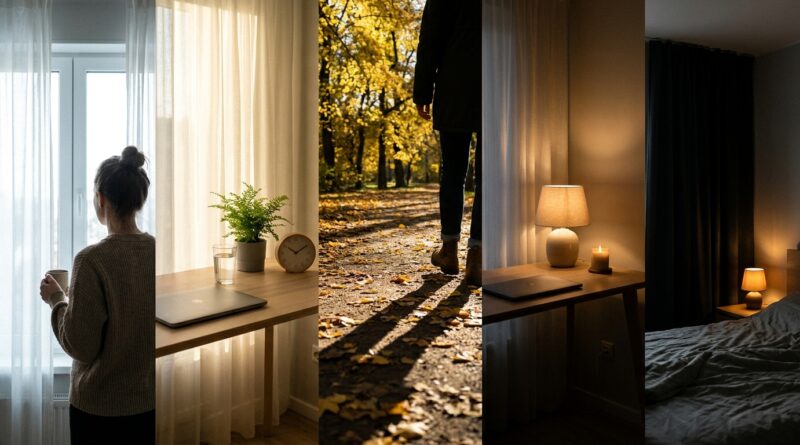
The 5‑Pillar Natural‑Light Workday: A Minimalist Way To Fix Your Energy Without More Coffee
You are not imagining it. The weird 2:30 p.m. brain fog, the restless sleep, the feeling that coffee stops helping after the second cup. It can show up right when the weather shifts and your habits have not caught up. Early autumn is sneaky like that. You are inside more, the mornings are dimmer, sunset arrives earlier, and your body clock starts drifting without much warning. If you work from home or freelance, it gets even easier to miss the cues that used to come from a commute, bright streets, or a busy office. The fix is often much less dramatic than a new app, planner, or supplement stack. A simple natural light minimalist productivity routine can help steady your energy, sharpen focus, and make sleep feel normal again. Think less biohacking, more using windows, short walks, and a few smart lighting choices at the right times.
⚡ In a Hurry? Key Takeaways
- Your energy may be dropping because your light exposure is out of sync, not because you need more coffee or better willpower.
- Use a five-pillar routine: get outdoor light early, work near daylight, step outside at midday, brighten late afternoon wisely, and dim your evenings.
- If low mood or sleep problems feel severe or do not improve, talk to a doctor. Light helps a lot, but it is not a cure-all.
Why your energy feels off all of a sudden
Your body runs on light. Not in a mystical way. In a very practical, biological one.
Light tells your brain when to feel alert, when to release melatonin later, and when to expect sleep. When summer fades and your routine stays the same, that signal gets messy. You wake up in dim light, spend hours under weak indoor bulbs, and then blast your eyes with bright screens at night. No wonder your system gets confused.
This is especially rough for remote workers. There is no train platform, no walk from the car park, no bright lobby, no regular lunch break outside. You can accidentally spend an entire day in the same pool of flat indoor light and then wonder why your focus collapses.
The 5-pillar natural-light workday
The goal is simple. Give your body clear light signals across the day, without turning life into a science project.
1. Get outdoor light within the first hour of waking
This is the anchor. Morning outdoor light is the strongest signal you can give your body clock.
Try 10 to 20 minutes outside soon after waking. If it is cloudy, still go. Daylight outdoors is usually far brighter than indoor light, even on a grey day. You do not need to stare at the sun. Just be outside. Walk, stretch, drink your coffee on the doorstep, or stand by the garden if that is what you have.
If mornings are dark where you live, sit by your brightest window as a backup, then get outside as soon as daylight arrives. Not perfect, but better than staying under a kitchen bulb until noon.
2. Put your main work block near a window
This is the easiest upgrade most people ignore.
If possible, move your desk closer to natural light. You do not need a designer office. You just want daylight in your visual field while you work. It helps alertness and gives your brain a clearer sense of daytime.
Do not overcomplicate this. Face the window if glare is manageable, or sit sideways to it if your screen reflects too much. If your room fights you, it may be worth rethinking the setup itself. That is where The 5‑Pillar Machine‑For‑Living Workday: A Minimalist Way To Turn Your Space Into Quiet Output fits nicely. Sometimes the problem is not motivation. It is the room.
3. Take a short outside break around midday
This is your anti-slump move.
A 10 to 15 minute walk around lunch can do more for your afternoon than another coffee. Midday light helps reinforce your daytime alertness and breaks the indoor cocoon effect that builds up by early afternoon.
You do not need a power walk. A slow loop around the block counts. If you can pair it with lunch pickup, a phone call, or a quick errand, even better. The point is to let your eyes and brain register bright outdoor light.
4. Use bright indoor light strategically in late afternoon
By 4 p.m., many homes start feeling cave-like in autumn.
If natural light is fading but you still need to work, turn on brighter room lighting before you feel yourself crashing. Cheap LED bulbs in a floor lamp or desk lamp can help more than people expect. You are not trying to make the room harsh. You are trying to stop the slow slide into sleepy twilight while your workday is still going.
This is where timing matters. Brighten your space during working hours. Then ease off later in the evening.
5. Dim things down at night
This is the pillar people skip, then wonder why they feel wired at bedtime.
If your body gets weak light all day and bright light at 10 p.m., it receives the exact opposite of the signal it needs. Try dimmer lamps after dinner, warmer bulbs where possible, and less screen glare in the final hour before bed.
You do not need candlelight and total silence. Just make your evenings look different from your workday. Lower contrast. Softer light. Fewer bright overheads.
What this looks like in real life
Here is a simple version:
7:30 a.m. Open curtains immediately. Step outside for 10 minutes with tea or coffee.
9:00 a.m. to 12:00 p.m. Do your hardest work near a window.
12:30 p.m. Walk outside for 10 to 15 minutes.
3:30 p.m. If daylight is fading, switch on brighter lamps before your energy drops.
8:30 p.m. Dim overhead lights. Use warmer, softer lighting and lower your screen brightness.
That is it. No wearable required. No expensive sunrise machine. No color-coded life dashboard.
Common mistakes that make the routine less effective
Thinking a sunny window equals outdoor light
Windows help, but outdoor light is usually much stronger. Morning outdoor exposure matters most.
Waiting until you feel awful to go outside
Light works better as a cue than a rescue. Build it in before the crash.
Using bright white light late into the night
Great at 4 p.m. Not great at 11 p.m. Match the light to the job.
Assuming coffee is the main fix
Coffee can help alertness, but it cannot replace missing daylight cues. If your timing is off, more caffeine often just papers over the problem.
Who benefits most from this
This routine is especially useful for freelancers, home workers, students, shift-adjusters, and anyone who has quietly become more indoor than they realise.
It also helps people who keep tinkering with productivity systems when the real issue is physical, not motivational. If you have been trying new to-do apps, stricter schedules, or complicated morning routines with mixed results, this is worth trying first.
What if your home is dark?
Many homes are. Especially flats, back rooms, and converted spare bedrooms.
Start with what you can control. Work in the brightest room for your first focus block. Open blinds fully. Clean the window if it is grimy. Add one or two brighter lamps for late afternoon. Then protect the evening by dimming things back down later.
You do not need a magazine-perfect workspace. You need clearer light signals.
When to get extra help
If your low mood is intense, your sleep is badly disrupted, or you feel exhausted no matter what you do, it is worth speaking to a doctor. Seasonal shifts can expose other issues, and persistent fatigue is not something to just push through.
But for many people, especially in early autumn, better light timing is a surprisingly solid first fix.
At a Glance: Comparison
| Feature/Aspect | Details | Verdict |
|---|---|---|
| Morning light | 10 to 20 minutes outdoors soon after waking helps set your body clock and improves daytime alertness. | Most important pillar |
| Midday outdoor break | A short walk around lunch helps reduce the afternoon slump and gives your brain a second strong daylight cue. | Best low-effort energy boost |
| Evening dimming | Lower, warmer light after dinner helps your body prepare for sleep instead of staying in work mode. | Essential for better sleep |
Conclusion
Right now, a lot of people are doing everything they can think of to fix their focus, while missing the quiet change happening outside the window. Early autumn means less daylight, more time indoors, lower mood for some people, patchy sleep, and that all-too-familiar productivity dip after lunch. If you work remotely, there is often no built-in routine to keep your body clock on track. The good news is that a natural light minimalist productivity routine does not ask much from you. A few minutes outside in the morning, a window for your main work block, a short midday walk, brighter light when the day fades, and dimmer evenings can go a long way. It is simple, cheap, and refreshingly low-tech. Sometimes better energy is not about doing more. It is about letting light do its job.