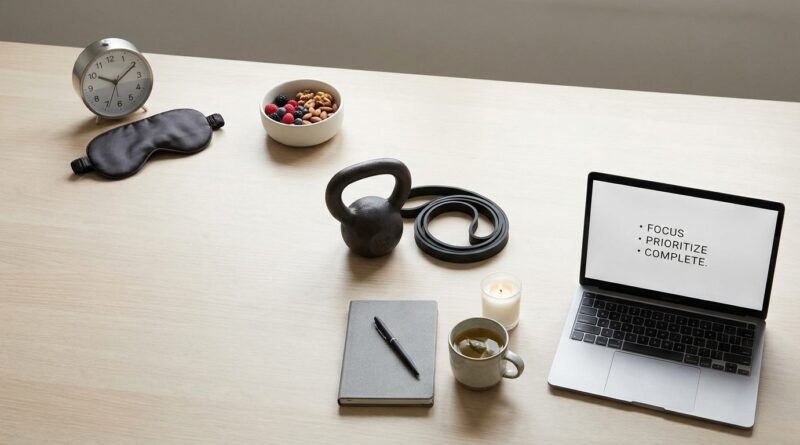
The 5‑Pillar Minimalist Health Stack: A Simple “Body First” System That Quietly Doubles Your Productivity
You can buy another planner. You can color-code your calendar. You can try the latest focus app that promises to fix your life in three taps. And still, the whole day can fall apart because you slept badly, grabbed lunch from a vending machine, and never stood up from your chair. That is not laziness. It is biology. A lot of us keep treating productivity like a software problem when it is really a body problem first. If your energy is unstable, your attention usually goes with it. If your stress is high, simple tasks start feeling weirdly heavy. The good news is that you do not need a lab, a smartwatch collection, or a 19-step morning routine. A simple minimalist health productivity system can do more for your output than another round of app shuffling. Think of it as a small body-first stack. Five pillars. Low drama. Real payoff.
⚡ In a Hurry? Key Takeaways
- A minimalist health productivity system works by fixing the physical basics that drive focus, mood, and stamina before you add more tools.
- Start with five pillars only: sleep, food, movement, hydration, and stress recovery. Set one tiny rule for each.
- This is not medical advice or a biohacking challenge. If you have health conditions, adjust with a professional. Keep it simple and sustainable.
Why your productivity system keeps breaking
Most people do not have a planning problem. They have an energy problem wearing a planning costume.
That sounds blunt, but it is also freeing. If your brain feels foggy after five hours of sleep, no task manager on Earth is going to turn you into a deep work machine. If your blood sugar is all over the place, your afternoon focus may vanish right on schedule. If you sit for ten hours, your body gets stiff, your mood drops, and your brain starts bargaining for snacks and distractions.
This is why the minimalist health productivity system idea is catching on. It starts with the machine doing the work. You.
What the 5-pillar minimalist health stack actually is
It is not a diet. It is not a fitness identity. It is not a self-improvement hobby.
It is a bare-bones personal operating system built around five inputs that affect nearly every workday:
- Sleep
- Nutrition
- Movement
- Hydration
- Stress recovery
The goal is not perfection. The goal is to remove the biggest physical reasons your day goes off the rails.
Pillar 1: Sleep, because everything else gets harder when this slips
If you only improve one thing, start here.
Bad sleep acts like a tax on every part of the next day. Focus is weaker. Cravings get louder. Patience shrinks. You tend to make more reactive choices, which then look like a motivation issue when they are really a recovery issue.
The minimalist version
Pick one sleep anchor, not five. For most people, the easiest is a consistent wake time, even if bedtime is still messy.
Try this:
- Set one wake time you can keep most days
- Cut bright screens 30 minutes before bed if you can
- Keep your room dark and a little cool
That is enough to start. You do not need a sunset lamp, mouth tape, or magnesium spreadsheet.
Pillar 2: Nutrition, because autopilot eating wrecks mental steadiness
You do not need a perfect meal plan. You need fewer energy crashes.
For productivity, the biggest food problem is often randomness. Coffee for breakfast. A giant carb-heavy lunch. No protein. Then a 3 p.m. slump that feels like your personality changed.
The minimalist version
Create a repeatable default for breakfast and lunch on workdays.
Good defaults are boring in a good way. They remove decision fatigue and smooth out your energy. Think simple:
- Protein first
- Add fiber when possible
- Keep easy backup options at home or work
Examples:
- Greek yogurt, fruit, and nuts
- Eggs and toast with fruit
- Chicken wrap, salad, and water
- Rice, beans, and pre-cooked protein
The point is not eating like an influencer. The point is making “what should I eat?” less likely to end in chips and regret.
Pillar 3: Movement, because a parked body creates a parked brain
You do not need to become a gym person to feel more switched on. But you do need to move enough that your body does not feel like office furniture.
Movement improves alertness, mood, and stress control. It also helps break the fake sense that you are “too busy” to take care of yourself. Often, five minutes is enough to reset your head.
The minimalist version
Use two layers:
- Daily baseline movement
- Optional exercise if you want it
Your baseline could be:
- A 10-minute walk after lunch
- Standing up every hour
- Five minutes of mobility before work
If you already exercise, great. Keep it. If you do not, start with walking. Walking is wildly underrated because it is not flashy. But it works.
Pillar 4: Hydration, because low energy is sometimes just low water
This one sounds almost too simple. That is why people skip it.
Mild dehydration can show up as headaches, tiredness, and muddy thinking. It can also make you mistake thirst for hunger or restlessness.
The minimalist version
Tie water to moments you already have:
- One glass when you wake up
- One with each meal
- Keep a bottle visible during work
That is it. No gallon challenge. No hydration app yelling at you every 14 minutes.
Pillar 5: Stress recovery, because a tense brain cannot do its best work
This is the pillar many productive people ignore until their body forces the conversation.
If your nervous system is running hot all day, your focus gets shallow. You become reactive. Small problems feel huge. You may still be “getting things done,” but in that brittle, edgy way that burns people out.
The minimalist version
Add one deliberate downshift each day:
- Five minutes of slow breathing
- A short walk without your phone
- Ten quiet minutes after work before switching into home mode
- A no-screen wind-down before bed
This matters more than it looks. Recovery is not wasted time. It is what keeps tomorrow from borrowing too heavily from today.
How to set this up in one afternoon
The biggest mistake is trying to rebuild your whole life by Monday.
Instead, create one rule per pillar. That gives you a complete minimalist health productivity system without making you babysit it.
Your one-afternoon setup
- Sleep: Choose a stable wake time
- Nutrition: Pick two repeatable workday meals
- Movement: Schedule one daily 10-minute walk
- Hydration: Put a water bottle where you work
- Stress recovery: Choose one 5-minute reset habit
Write these down somewhere visible. A sticky note is fine. This is not the place for a complicated dashboard.
Why simple works better than “optimal”
Because optimal usually collapses under real life.
The best system is not the most advanced one. It is the one that still works on a bad Tuesday. The one you can keep when work gets busy, your kid gets sick, or your motivation goes missing for a week.
That same idea applies to your environment too. If your space constantly pulls your attention away, even a good body-first system has to fight uphill. That is where The 5‑Pillar Minimalist Home Focus System: A Simple Way To Make Your Space Work Like A Second Brain fits nicely. Your body and your space work as a team. When both are less chaotic, your brain spends less energy compensating.
What changes first when you get this right
Usually, the first shift is not magical productivity. It is friction dropping.
You stop arguing with yourself quite so much. Mornings feel less jagged. The afternoon slump softens. You can hold attention longer. Small tasks feel less dramatic. That may sound modest, but those tiny wins stack fast.
Within a few days, many people notice:
- More stable energy
- Less random snacking
- Better patience and mood
- Less dependence on willpower
- More consistent work output
That is the quiet productivity boost. Not hustle. Not hype. Just fewer physical reasons to fall apart before dinner.
Common mistakes to avoid
1. Starting with supplements instead of sleep
Supplements may have a place, but they are usually not the first domino.
2. Making every pillar ambitious
If all five habits are hard, you have built a stress system, not a health system.
3. Chasing perfection after one good day
A nice walk and a good breakfast do not mean you need to redesign your entire personality by sunset.
4. Confusing stimulation with energy
More caffeine can feel like more power, until it turns into jitters, poor sleep, and another rough morning.
Who this system is best for
This setup is especially helpful if you:
- Keep trying new productivity tools with mixed results
- Work at a desk most of the day
- Feel tired but wired
- Want better focus without turning wellness into a full-time job
It is also good for people who hate complexity. Honestly, that may be the secret advantage.
At a Glance: Comparison
| Feature/Aspect | Details | Verdict |
|---|---|---|
| Complex productivity stack | Multiple apps, detailed planning, lots of rules, often ignores sleep and energy | Useful for organization, but weak if your body is running on fumes |
| Minimalist health productivity system | Five simple pillars: sleep, food, movement, hydration, stress recovery | Best starting point for steadier focus and sustainable output |
| Biohacking-style optimization | Heavy tracking, gadgets, protocols, and constant tweaking | Can help some people, but often too complicated for daily life |
Conclusion
If your days keep collapsing no matter how tidy your task list looks, it may be time to stop treating productivity like a pure planning problem. Right now the trend across fitness, wellness and productivity circles is brutally clear: people are walking away from complicated life-operating systems and asking a simpler question. How do I get more done by fixing the foundations first? Usually that means sleep, nutrition, movement, hydration, and stress. A minimalist health-first stack gives you a practical answer in one afternoon. No obsession required. No biohacking costume needed. Just a few solid defaults that help you feel different within days, so you can stop endlessly reorganizing apps and start working with a body that actually supports the life you want.