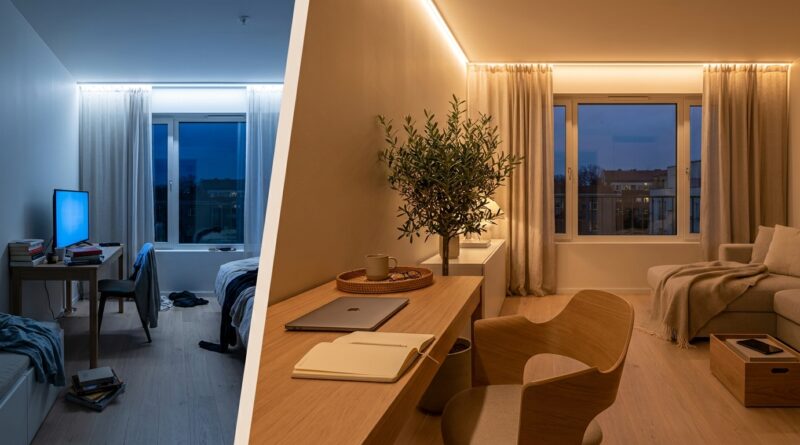
The 5-Switch Sanctuary: A Minimalist Way To Turn Any Room Into A Focus Bubble By Tonight
You are not lazy, unfocused, or bad at productivity. Sometimes the real problem is the room itself. The overhead light feels like a dentist office. Your phone keeps winking at you. A half-folded laundry pile sits in the corner like an open browser tab for your brain. By midafternoon, your space has quietly drained your attention before you even start the hard work. That is why a minimalist home sanctuary for productivity matters more than another to-do app.
The good news is you do not need a shopping list, a full weekend reset, or one of those perfect Instagram desks. You just need five simple switches. Think of them as quick environmental toggles that tell your brain, “This is the focus zone now.” Once you set them up, you can flip your room from general life chaos into a small, protective bubble of calm in a few minutes. By tonight, you can make one corner work with you instead of against you.
⚡ In a Hurry? Key Takeaways
- Build a focus bubble with five fast switches: light, sound, screen, surface, and signal.
- Set each switch to one simple “work mode” so your brain gets the same cue every time.
- This works best because it uses what you already have. No new gear, no app stack, no major declutter required.
What the 5-Switch Sanctuary Actually Is
This is not a room makeover. It is a tiny system.
You pick one spot. A desk, the end of the dining table, one chair by a lamp, even a cleared section of the kitchen counter. Then you give that spot five repeatable settings. Every time you want to focus, you click those settings into place.
That is the trick. Not perfection. Repeatability.
Minimalism often gets sold as owning less. But for most people, the real win is reducing friction. A minimalist home sanctuary for productivity should make the right thing easier to start.
The Five Switches
1. Light Switch: Make the Room Stop Shouting
Bad lighting is sneaky. Harsh overhead bulbs keep your body alert in the wrong way, while dim corners make you sluggish.
Your job here is simple. Choose one lighting setup for focus mode.
That might mean turning off the ceiling light and using a side lamp. Or opening one blind halfway and closing the rest. Or facing your seat toward natural light instead of the TV.
The rule is this: softer, steadier, and aimed at the task.
If the light makes you squint or feel exposed, it is wrong for focus.
2. Sound Switch: Reduce the Tiny Interruptions
You do not need silence. You need fewer surprises.
The barking dog outside, the group chat ping, the washing machine beep, the TV in the next room. None of these seem huge on their own. Together, they chew your attention into bits.
Pick one sound setting for focus mode:
Close the door. Turn on a fan. Use foam earplugs. Ask your smart speaker for rain sounds. Put your phone on silent and face down in another spot.
The best sound environment is not always quiet. It is predictable.
3. Screen Switch: Stop Letting Every Device Vote
If three screens are visible, your brain will keep checking all three.
This switch is about visual temptation, not self-control. Put the tablet away. Turn off the TV. Mute the smartwatch. Set your phone to Do Not Disturb and place it behind you or across the room.
If your work needs the computer, fine. Let that be the only active screen.
If doomscrolling is part of your evening problem too, you will probably like The 5-Rule Bedroom: A Minimalist Night Sanctuary To Kill Doomscrolling For Good. It uses the same basic idea. Your environment should not have equal voting rights with your intentions.
4. Surface Switch: Clear Only the Work Footprint
This is where people get stuck. They think they need to clean the whole room before they can focus.
You do not.
Clear only the footprint you need for the next task. Laptop, notebook, pen, water. That is it. Everything else can stay somewhere else for now.
Not hidden forever. Just moved out of your visual lane.
A single clean rectangle of space can calm your brain more than an hour of random tidying.
5. Signal Switch: Give Your Brain a Start Cue
This is the most overlooked part.
Your brain needs a small ritual that says, “We are beginning.” Without that cue, your room still feels like mixed-use life soup. Office, gym, dining area, living room, all mashed together.
Your signal can be tiny:
- Fill one glass of water and place it in the same spot.
- Light a candle, if safe for your setup.
- Put on one specific sweater or pair of headphones.
- Set a 25-minute timer.
- Write the single next task on a sticky note.
It sounds almost too simple. But repeated cues matter. They help your body recognize focus mode before your mind starts arguing.
How to Set Up Your Focus Bubble Tonight
Here is the fast version.
Step 1: Choose one exact spot
Do not say “my room.” Say “left side of desk” or “chair by the bookshelf.”
Step 2: Decide your five default settings
Example:
- Light: side lamp on, overhead off
- Sound: fan on, phone silent
- Screen: laptop only, phone in drawer
- Surface: notebook, pen, water only
- Signal: 25-minute timer and one sticky-note task
Step 3: Test it for one short session
Not three hours. Try 20 to 30 minutes.
The point is not to become a new person by bedtime. The point is to prove the setup works.
Step 4: Adjust what annoys you
If the chair is uncomfortable, fix that tomorrow. If the lamp is still too bright, change the bulb later. If the phone is too tempting, move it farther away.
You are building a usable sanctuary, not a showroom.
Why This Works Better Than Random Productivity Hacks
Most hacks ask your brain to fight upstream. This one changes the current.
When your space has a repeatable on-state and off-state, you spend less energy deciding, resisting, and recovering. That matters, especially if your home has to do too many jobs at once.
And that is most homes now.
One room is often trying to be five rooms. A micro-sanctuary gives you a small protected zone inside that chaos. It is not dramatic. It is practical. Which is why people actually keep doing it.
Common Mistakes to Avoid
Trying to optimize the whole house
Start with one spot. One. You can expand later.
Buying gear before testing the system
Do not order desk accessories because you feel productive while browsing them. Use what you have first.
Making the ritual too complicated
If your five switches take 20 minutes, you will stop using them. Aim for under three minutes.
Confusing cozy with useful
A focus sanctuary can be pleasant, but it still needs to support action. If the chair puts you to sleep, it is not a focus setup.
At a Glance: Comparison
| Feature/Aspect | Details | Verdict |
|---|---|---|
| Setup time | Usually 10 to 15 minutes to pick one spot and define the five switches | Fast enough to do tonight |
| Cost | Uses existing lights, furniture, and device settings in most homes | High value, low effort |
| Best benefit | Creates a reliable mental on/off state for work without a full declutter | More useful than chasing another app or hack |
Conclusion
You do not need a perfect apartment, a custom office, or monk-level discipline to focus better. You need one small zone that stops fighting you. Right now everyone is drowning in ambient noise. Screens, alerts, bad lighting, and rooms that try to be office, gym, and living room all at once. The 5-switch sanctuary gives you a concrete, fast way to claim one protective bubble of clarity without buying gear, downloading apps, or doing a full declutter. That is why this idea matters. It solves the real bottleneck of modern minimalist living, which is not owning less in theory, but having a low-effort, repeatable way to click your environment into a mental on or off state when life gets noisy. Start with one corner tonight. Small counts.