The 5‑Pillar Slow‑Living Workday: A Minimalist Way To Get More Done By Doing Everything Slower On Purpose
You can get plenty done and still stop treating every workday like a timed obstacle course. If you are worn out by productivity advice that turns breakfast, email, meetings, and even bathroom breaks into chances to “do more,” that makes sense. A lot of people are not failing at work. They are reacting to a work rhythm that never lets the nervous system settle. The answer is not to become lazy or careless. It is to work slower on purpose in a few smart places so your day stops feeling like a constant chase. A slow living workday is not about candles, cottagecore, or pretending deadlines do not exist. It is a minimalist productivity pattern for real life. You start with less friction, move with more intention, pause before your brain crashes, cut back on screen chaos, and close the day in a way that helps tomorrow feel possible instead of dreadful.
⚡ In a Hurry? Key Takeaways
- A slow living workday means doing key parts of your day more deliberately, not doing less work overall.
- Use five simple pillars: slower start, steadier pacing, real pauses, fewer screen jumps, and a clean wind-down.
- This approach helps protect focus and stress levels without requiring a new job, a perfect routine, or expensive tools.
Why “slower” can actually make you more productive
The strange thing about modern work is that speed often creates waste. You reply too fast, switch tasks too fast, say yes too fast, and skim too fast. Then you spend half the day fixing mistakes, rereading messages, and trying to remember what you were doing before the latest ping pulled you away.
That is why the search for slow living workday minimalist productivity is growing. People are not asking how to cram 19 tasks into 11 minutes. They want a calmer way to do meaningful work without feeling fried by 3 p.m.
Slow living at work does not mean moving in slow motion. It means removing rushed, twitchy, reactive behavior from the parts of the day where it does the most damage.
The 5 pillars of a slow-living workday
1. Start gently, not instantly
A lot of work stress begins before work even starts. You wake up, grab your phone, scan bad news, check Slack, see three urgent emails, and your body is already acting like it is late for something.
A minimalist slow-living workday begins with a small buffer. Ten to twenty minutes is enough. No heroic morning routine needed.
Try this:
- Do not check messages the second you wake up.
- Drink water, open a curtain, stretch, or step outside for two minutes.
- Write down the top one to three things that would make the day feel solid.
This kind of slower start lowers friction. It also keeps your priorities from being hijacked by whoever contacted you first.
2. Pace your day in bigger blocks
Many people are not overloaded only because they have too much to do. They are overloaded because they are changing lanes all day long. Email, doc, chat, spreadsheet, call, back to email, then a quick scroll because your brain wants relief.
That pace is exhausting.
Slow living work uses fewer, bigger blocks. Instead of reacting all day, group similar work together and stay with it longer.
For example:
- Block 1 for deep work
- Block 2 for meetings or collaboration
- Block 3 for admin, email, and loose ends
This is also where brain care matters. If your attention keeps collapsing, the issue may not be discipline at all. It may be overload. That is why The 5-Pillar Brain-First Workday: A Minimalist Way To Fix Your Focus By Protecting Your Head, Not Your Inbox is such a useful companion read. It frames focus as something you protect, not something you bully into existence.
3. Pause before you feel desperate
Most people wait too long to take a break. They push until they are foggy, irritable, hungry, and weirdly angry at an innocent spreadsheet.
Slow living asks you to pause sooner. Not for an hour. Just long enough to interrupt the build-up.
Good pause ideas:
- Stand up every 60 to 90 minutes
- Look away from screens for a few minutes
- Take a short walk without your phone
- Eat lunch somewhere that is not your keyboard
These pauses are not lazy. They are maintenance. Your brain is not a browser tab that stays fine with 47 windows open.
4. Reduce screen switching and digital noise
This pillar is where a lot of relief lives.
The always-available digital environment is not neutral. Every icon badge, every preview, every open tab, every half-read notification is asking for a tiny piece of your attention. One piece is small. Fifty pieces becomes your whole afternoon.
To slow the day down, make your screens less noisy:
- Close tabs you are not using now
- Turn off non-essential notifications
- Check email at set times instead of constantly
- Keep chat tools muted during focus blocks if your job allows it
- Use one written task list instead of five scattered reminder systems
Minimalist productivity is often less about finding the perfect app and more about removing digital clutter that keeps poking your brain.
5. End the day slowly enough that tomorrow is not a mess
A rushed finish creates a rough start the next day. You close the laptop with ten tabs open, no clear next step, and a vague feeling that you forgot something important. That feeling follows you into the evening.
A slow-living workday ends with a short shutdown ritual. Five to ten minutes is enough.
At the end of the day:
- Write down what got done
- Choose the first task for tomorrow
- Close tabs and file loose notes
- Log out of work apps if possible
This helps your brain stop carrying unfinished work around like a backpack full of bricks.
What this looks like in a real workday
A simple example
Here is a basic version you can run tomorrow:
- 8:30 Start without inbox first. Review your top three priorities.
- 8:45 to 10:30 Do your most important work in one focused block.
- 10:30 Take a real break. Stand up, water, breathe, walk.
- 10:45 to 12:00 Meetings or lighter tasks.
- 12:00 to 1:00 Lunch away from your desk if possible.
- 1:00 to 2:30 Second work block.
- 2:30 Short reset instead of forcing through the slump.
- 2:45 to 4:00 Admin, email, coordination.
- 4:00 to 4:10 Shutdown ritual for tomorrow.
Notice what is missing. No minute-by-minute optimization. No guilt-packed hustle theater. Just a calmer structure that still respects reality.
Common mistakes when people try to work more slowly
Making it too pretty
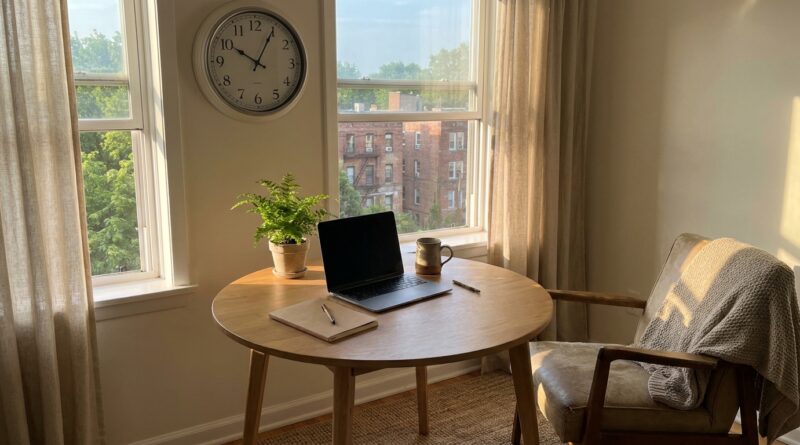
You do not need a perfect notebook, special tea, a matching timer, and a sunlit desk by a window overlooking a forest. Nice if you have it. Not required.
The goal is lower friction, not a lifestyle performance.
Turning slow living into another rigid system
If your “calm routine” becomes one more thing to fail at, it stops being useful. These pillars are supports, not rules.
Use them loosely. Adjust for kids, shift work, caregiving, office culture, or deadline weeks.
Confusing calm with low standards
You can still be ambitious. You can still care deeply about your work. A slower pace in key moments often improves the quality of what you produce because you are less scattered while doing it.
Who this method helps most
This approach is especially good for people who:
- Feel constantly “on” even when they are home
- Work on screens all day
- Lose time to task switching
- Hit an afternoon wall most days
- Want a more human routine without dropping their goals
If that sounds familiar, this is not about becoming a different person. It is about building a day your current nervous system can actually live with.
At a Glance: Comparison
| Feature/Aspect | Details | Verdict |
|---|---|---|
| Morning start | Slow-living approach avoids instant inbox checking and starts with a short buffer and clear priorities. | Best for lowering stress before the day runs away from you. |
| Work pacing | Uses larger task blocks and fewer context switches instead of constant multitasking. | Better for focus, energy, and fewer mistakes. |
| End-of-day routine | A short shutdown ritual helps you leave work without carrying mental clutter into the evening. | High value, very low effort. |
Conclusion
The loudest trend in productivity right now may be the quietest one. People are mixing slow living with real-world work because they want routines that protect their wellbeing without giving up on their jobs or their ambitions. A 5-pillar slow-living workday gives you a concrete, minimalist pattern you can try tomorrow. Start more gently. Pace work in bigger chunks. Pause before burnout. Cut screen chaos. Close the day cleanly. That is it. Fewer moving parts, more impact, and a workday that feels human instead of hostile.