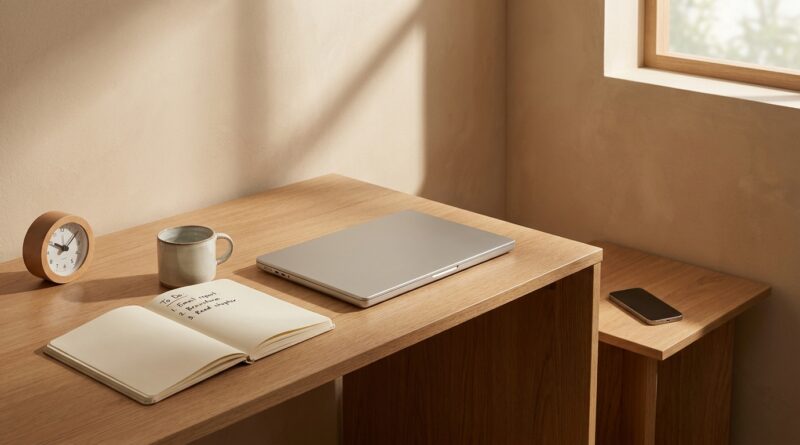
The 5‑Trigger Desk: A Minimalist Way To Make Your Workday Start Itself
You know this feeling. You sit down to work with good intentions, open your laptop, and somehow the next 40 minutes vanish. A few inbox pings. A couple of tabs you did not mean to open. One tiny choice about what to start first, then another, then another. By the time you finally get to the real task, your brain already feels used up. It is not laziness. It is friction. The start of the workday is where focus gets lost most easily, especially when your desk asks you to make too many little decisions.
A minimalist desk setup for productivity triggers fixes that by turning your workspace into a quiet set of cues. You do not need a new app, a color-coded planner, or a full life reset. You need five simple triggers that tell your brain, in the same order every day, “we are working now.” Done right, your desk starts your workday almost by itself.
⚡ In a Hurry? Key Takeaways
- A five-trigger desk uses simple physical and digital cues to start work with less hesitation and fewer distractions.
- Set up one clear order: sit, light, notebook, focus screen, first task. The less you choose in the moment, the faster you begin.
- Keep it minimal. If a trigger adds clutter or stress, it is not helping. The goal is a calmer start, not a more complicated routine.
What a 5-Trigger Desk Actually Is
Think of it as a start-up sequence for your brain.
Not a giant productivity system. Not a morning routine that takes half an hour. Just five cues, always in the same order, that move you from “I just sat down” to “I am doing the first real task.”
The reason this works is simple. Most people do not lose focus because they are bad at working. They lose it in transition moments. Sitting down. Switching tasks. Coming back from lunch. That is where random decisions sneak in and steal attention.
A good minimalist desk setup for productivity triggers cuts down those decisions. Your environment does more of the reminding, so your brain has less to manage.
The 5 Triggers
1. The clear desk trigger
Your desk should show only what belongs to the first hour of work.
That usually means your laptop, one notebook, one pen, water or coffee, and maybe a lamp. That is it. If yesterday’s papers, chargers, sticky notes, and unopened mail are still there, your brain reads all of that as unfinished business.
This first trigger happens before the day starts. Do a two-minute reset at the end of the day so tomorrow’s desk already looks ready.
What it tells your brain: There is nothing here to sort out first.
2. The light trigger
Use one physical signal that means work has begun. A desk lamp is perfect for this.
When you sit down, turn on the same lamp every time. If you work near a window, open the blinds in the same motion. The point is not decoration. It is consistency.
This sounds almost too small to matter, but small physical rituals stick because they ask very little from you. They are easy to repeat, even on low-energy days.
What it tells your brain: We are entering focus mode.
3. The open notebook trigger
Before you touch email or chat, open a notebook and write one line: the first important task.
Not your whole to-do list. Not a fresh planning session. Just the next meaningful thing.
Examples:
Finish slide 3 and 4.
Draft opening paragraph.
Review budget notes for 20 minutes.
This matters because the brain hates a vague start. “Do some work” is fog. “Edit section two” is a doorway.
What it tells your brain: This is what winning the next block looks like.
4. The focus screen trigger
Your laptop should open to one intentional screen, not a buffet of temptations.
For some people that is a blank document. For others it is a task manager with one pinned item. If your browser restores 17 tabs, news, messages, and social feeds, your setup is making your mornings harder than they need to be.
Try this simple rule. When you shut down for the day, leave tomorrow’s first file or page ready to open first. If needed, use a separate browser profile just for work.
What it tells your brain: Start here, not everywhere.
5. The first-action trigger
The last trigger is the smallest possible move into real work.
Not “work on report.” More like “write the title,” “reply to the one approval email,” or “highlight the next paragraph to edit.” The key is to make the first action so clear and so small that you can do it before your mind starts bargaining with you.
This is where many routines fail. They prepare beautifully, then stop right before actual effort. Your fifth trigger closes that gap.
What it tells your brain: We already started.
Why This Works Better Than Complicated Systems
A lot of productivity advice asks you to maintain too much. More apps. More categories. More check-ins. More rules.
That can feel exciting for three days. Then life gets messy, energy drops, and the whole system collapses under its own weight.
The 5-trigger desk works because it is light. It does not ask you to become a different person. It simply removes a few points of friction from the most fragile part of the day.
That is why so many people are drifting back to simple habits. They are easier to trust, easier to repeat, and much kinder on tired brains.
How to Build Your Setup in One Evening
Step 1. Remove what does not help you start
Look at your desk and ask one question: does this help me begin work in the first five minutes?
If not, move it. You do not need to throw everything away. Just get it out of your immediate work zone.
Step 2. Choose one trigger from each category
Your five triggers can be simple:
- Clear desk
- Lamp on
- Notebook open
- One focus screen
- One tiny first task
Do not over-design this. If you spend an hour researching the best desk lamp, you are already missing the point.
Step 3. Put them in a fixed order
The order matters more than the individual tools. Repetition is what turns cues into habit.
A good sequence might be:
Sit down. Turn on lamp. Put phone face down. Open notebook. Write first task. Open work file. Begin.
Step 4. Test it for one week
Do not judge it after one morning. Give it five workdays.
If one trigger feels annoying or pointless, trim it. Minimalism is not about making your desk empty for the sake of it. It is about keeping only what helps.
Common Mistakes
Using too many triggers
If you have a special playlist, a candle, a timer, a stretch routine, a handwritten mantra, a tea ritual, and three apps, you no longer have a simple setup. You have a pregame show.
Five is enough.
Letting notifications be part of the opening scene
If Slack, Teams, or email are the first thing you see, they will decide your priorities for you.
Start with your work, then check messages on purpose.
Confusing comfort with clutter
A personal desk is fine. A chaotic desk is draining. Keep the few objects that make the space pleasant, but do not let them crowd out your start sequence.
Who This Helps Most
This approach is especially useful if you:
- work from home and struggle to “arrive” mentally
- have an attention span that gets hijacked by tabs and pings
- start the day tired and need less decision-making, not more
- have tried elaborate productivity systems and quit them
It is also helpful for people with hybrid schedules. When your work location changes, stable triggers create a little continuity.
At a Glance: Comparison
| Feature/Aspect | Details | Verdict |
|---|---|---|
| Setup time | Can be built in a single evening with items you already own | High value, low effort |
| Daily mental load | Cuts down tiny choices at the start of the day | Excellent for reducing decision fatigue |
| Long-term stickiness | Simple habits are easier to repeat than complex systems | More likely to last |
Conclusion
If your workday keeps slipping away in the first 15 minutes, you probably do not need more motivation. You need a gentler start. A minimalist desk setup for productivity triggers gives you that by replacing scattered choices with a few reliable cues. Right now people are tired of complicated systems that look smart but feel heavy. Small habits are winning because they actually survive real life. With a five-trigger setup you can put in place tonight, you can protect the most fragile part of the day, the moment you sit down to begin. That means less decision fatigue, fewer false starts, and a steadier rhythm in a year when most of us are trying to do more with less energy. Keep it simple. Make the start easier. The rest of the day has a much better chance when the first few minutes stop fighting you.