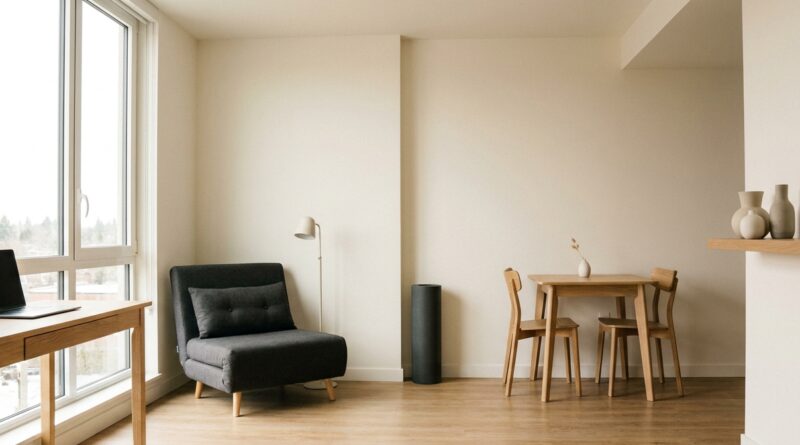
The 5‑Square Life: A Minimalist Way To Turn Tiny Spaces Into Big Productivity
Trying to answer emails from the same spot where you sleep, eat, scroll, and decompress can make your whole room feel like a buzzing to do list. That is the real problem with small-space living. It is not just clutter. It is that your brain stops getting clear signals about what time it is and what mode you are supposed to be in. So even when you are sitting still, your mind feels busy. If you have been hunting for the perfect minimalist small space productivity setup, the answer may not be a bigger desk, a prettier lamp, or another organizing app. It may be smaller than that. Much smaller. The 5-square life is a simple way to divide one cramped room into five tiny purpose zones based on what you actually do every day. You are not decorating. You are giving your brain boundaries, so focus feels easier and rest stops feeling like unfinished work.
⚡ In a Hurry? Key Takeaways
- The 5-square life turns one room into five tiny zones for work, rest, admin, recharge, and transition.
- Start with tape, a tray, a mat, or a lamp to mark each zone instead of buying more furniture.
- This method works best when each square has one job only, which cuts visual noise and decision fatigue.
Why tiny spaces drain your focus so fast
Most small rooms fail for one simple reason. Everything is happening everywhere.
Your bed becomes an office. Your table becomes a desk, dining area, and dumping ground. Your phone charger becomes a permanent roommate. Then your brain has to keep figuring out, over and over, what this space is for right now.
That constant switching is tiring. Not because you are doing anything wrong, but because your environment keeps sending mixed messages.
A good minimalist small space productivity setup does not try to make your room look bigger. It tries to make your room feel clearer.
What the 5-square life actually is
The idea is simple. Pick five small zones in your room. Not five rooms. Not even five corners if you do not have them. Just five clearly defined footprints, each with one purpose.
Think of each square as a cue. When you step into it, your brain knows what happens there.
The five basic squares
1. Work square. This is where focused work happens. Laptop, notebook, charger, done.
2. Admin square. Bills, forms, calendar checks, quick messages, life maintenance. This keeps low-energy tasks from spilling into your focus area.
3. Recovery square. Reading, stretching, breathing, quiet coffee, staring out the window. No work here.
4. Living square. Eating, hobbies, chatting, watching one episode, folding laundry. Daily life goes here.
5. Transition square. This is the overlooked one. It is where you reset. Bag drop, tomorrow’s clothes, water bottle, keys, shutdown note. It helps your day start and stop cleanly.
These squares can overlap in a very small room, but they should not feel identical. Each needs a visible signal.
How to build a 5-square setup without buying much
This is where people usually overcomplicate things. You do not need matching storage boxes and a Scandinavian pegboard wall.
You need markers.
Use physical cues, not just mental rules
Your brain responds well to simple sensory differences. Try things like:
- A small rug or mat for the recovery square
- A tray for the admin square
- A task lamp that only turns on during work
- A folding table or lap desk for focused tasks
- A basket by the door or bed for your transition square
The marker matters more than the price. A $10 tray can do more for your day than a $300 chair if it tells your brain, this is where paperwork goes and nowhere else.
Keep each square absurdly small
That is the trick. Do not think in terms of full furniture layouts. Think in terms of a footprint.
Your work square might be one chair, one surface, and one light.
Your recovery square might be a floor cushion and a blanket.
Your transition square might be a crate and a hook.
Small is good. Small is easier to keep stable.
The real benefit is fewer decisions
People often think productivity problems come from motivation. A lot of the time, they come from setup friction.
When every activity starts with clearing space, finding cables, moving yesterday’s dishes, and wondering where to sit, you waste energy before the real task begins.
The 5-square life lowers the number of decisions your brain has to make.
You do not ask, where should I work today?
You already know.
You do not ask, where should I put this paper?
You already have an admin square.
You do not collapse onto the bed after work and accidentally keep checking Slack for another hour.
You move into a different square, and the day changes with you.
How to choose your five squares based on your actual day
Do not copy someone else’s setup. Watch your own routine for two days.
Ask yourself:
- Where do I do my best focused work?
- Where do small annoying tasks pile up?
- Where do I actually recover, not just scroll?
- What part of my day feels messy at the start or end?
- Which activity keeps invading the rest of the room?
Your answers tell you where the squares need to be.
For example, if your biggest problem is that work invades bedtime, your strongest boundary should be between the work square and the recovery square. If your problem is constant visual mess, the transition square may matter most because it catches loose items before they spread.
One simple example in a studio or bedroom corner
Let us say you have one room, a bed, a small table, and not much else.
A practical 5-square map
Work square: Left half of the table, laptop stand, headphones, one notebook.
Admin square: Right side of the table, one document tray, pen cup, mail folder.
Recovery square: Floor cushion by the window, throw blanket, book.
Living square: End of the bed or a small stool for meals, hobbies, or casual phone use.
Transition square: Basket near the door or dresser with keys, bag, charger, and tomorrow list.
Notice what is missing. There is no giant office zone. No furniture overhaul. Just five jobs, clearly assigned.
Make the work square calmer, not just efficient
If your desk technically works but still leaves you fried, it may be missing sensory boundaries. Light, touch, scent, and sound all affect whether a tiny workspace feels grounded or irritating.
That is why a small ritual can help. If you want ideas for making your work square feel more focused without adding clutter, this guide on The 5‑Sense Desk: A Minimalist Workspace Ritual That Calms Your Nervous System And Doubles Your Focus is worth a look. It is a good companion to the 5-square idea because both are really about giving your brain better signals.
Rules that make this system work
The method is flexible, but a few rules matter.
Rule 1: One square, one main job
If your recovery square becomes a snack zone, doomscroll zone, and work overflow zone, it stops helping.
Rule 2: Reset takes under two minutes
If returning a square to normal takes too long, you will stop doing it. Aim for quick resets.
Rule 3: Open storage beats deep storage
For daily items, use easy access storage. If you have to dig, items migrate.
Rule 4: End work with a physical shutdown
Close the laptop. Turn off the lamp. Stack the notebook. Move the charger. Tiny actions matter because they tell your brain work is over.
Common mistakes people make
Trying to make every square pretty. Function first. You can make it look nice later.
Starting with products instead of patterns. Watch how you live before you shop.
Making the work zone too big. Big work zones tend to spread and take over.
Ignoring recovery. If there is no place in the room that means off, you never really feel off.
Using your bed as the backup zone for everything. That is often the habit that causes the most mental spillover.
At a Glance: Comparison
| Feature/Aspect | Details | Verdict |
|---|---|---|
| Space needed | Uses tiny footprints, shared surfaces, and simple visual markers instead of separate rooms | Excellent for bedrooms, studios, and kitchen-table setups |
| Cost | Can be built with tape, trays, baskets, lights, or items you already own | Low-cost and more useful than buying random desk gear |
| Daily impact | Creates clearer cues for focus, admin tasks, rest, and day-start/day-end routines | High payoff because it reduces mental clutter and decision fatigue |
Conclusion
If your home feels like it is asking you to work all the time, the fix is not always more storage, more apps, or more inspiration photos. Sometimes the answer is giving each part of your day a tiny place to land. Right now a lot of people are stuck working from a corner of a bedroom, a kitchen table, or a tiny studio and the default advice is to copy Pinterest offices or buy more gear. This 5-square idea flips it: you start with the smallest possible footprint and design five purpose zones around your real day, so you get more focus, better recovery, and less decision fatigue without needing more room or more stuff. Start small. One square at a time is enough.