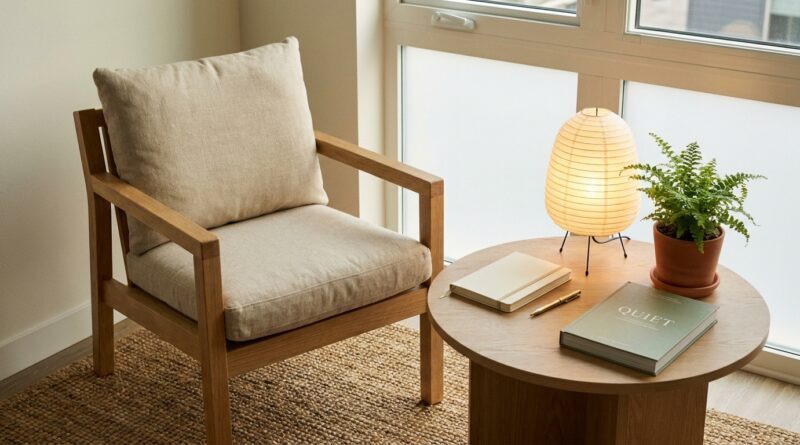
The 5‑Pillar Analog Corner: A Minimalist Way To Get Deep Focus Back In A Screen‑Soaked Home
You know the feeling. You sit down to relax, but your eyes keep drifting to a screen. A work laptop on the table. A phone lighting up on the armrest. A tablet somewhere nearby, quietly promising “just one quick check.” After a while, home stops feeling like home. It starts feeling like a waiting room for the next notification. That is why so many people are building a small analog room minimalist productivity corner instead of trying to fix their whole house at once. It is simpler, cheaper, and much more realistic.
The good news is you do not need a special studio, a Pinterest-perfect reading nook, or a weekend-long makeover. One chair, one lamp, one notebook, and a few clear rules can change the mood of an entire day. Think of it as a tiny low-tech island inside a noisy digital sea. If you set it up well, this corner becomes the place where your brain finally stops bracing for pings and starts doing something better. Thinking deeply. Reading slowly. Planning clearly. Resting for real.
⚡ In a Hurry? Key Takeaways
- A small analog corner can help you get deep focus back without redesigning your whole home.
- Use five pillars: clear boundaries, comfortable seating, paper tools, calm lighting, and simple rules.
- The goal is not to hate technology. It is to give your nervous system one place where it can finally stand down.
Why one small corner works better than a big plan
Big home resets sound nice. They also tend to die around day three.
That is why this idea works. You are not trying to turn your entire home into a cabin in the woods. You are carving out one square of life that has a different job. This is where you go to think, sketch, read, journal, plan your week, or simply breathe without being interrupted by glowing rectangles.
Our brains are very responsive to cues. If the couch is where you scroll, your brain learns “couch equals input.” If one chair by a warm lamp becomes your analog corner, your brain starts to learn “this is where we slow down.” That is not magic. It is repetition.
The 5 pillars of an analog room minimalist productivity corner
1. A clear boundary
Your corner needs to feel separate, even if it is just three feet from everything else.
You can do this with a small rug, a side table, a lamp, a bookshelf, or even the direction your chair faces. The point is simple. When you step into this spot, you should feel a small mental click. Different zone. Different pace.
Do not overcomplicate it. A corner by a window is great. A quiet spot in the bedroom can work. A section of the dining room is fine too, as long as it is not piled with chargers and unopened mail.
If possible, keep screens out of your line of sight. Even a black TV screen can pull at your attention because your brain knows what it is for.
2. Real comfort, not fake aesthetic comfort
A lot of “cozy corners” look good in photos and feel terrible after ten minutes.
Your body has to want to stay here. That means a chair with support. A cushion that does not flatten instantly. A blanket if the room runs cold. A table or surface at the right height so you are not hunching over like a shrimp while trying to journal.
Deep focus is not only mental. It is physical. If your neck hurts, your mind will go looking for escape. Usually that means your phone.
3. Paper tools that earn their place
The best analog corners are not stuffed with supplies. They are edited.
Start with three basics. A notebook. A pen you actually enjoy using. A book or printed material worth your attention. That is enough for most people.
If you want, add a timer, index cards, sticky notes, or a printed weekly planner. But be picky. Every item should have a job. Otherwise your “focus corner” turns into a hobby graveyard.
A good test is this. Can you sit down and begin within ten seconds? If yes, you have the right setup.
4. Lighting that tells your brain to settle
Harsh overhead light makes almost everything feel like an office or a waiting room.
Use warmer, softer lighting if you can. A small lamp is often enough. Natural light is even better during the day. If your corner is near a window, you are ahead already.
Light matters because it sets the emotional temperature of a space. Bright, cold light says “perform.” Warm, softer light says “stay awhile.” For reading, planning, and recovery, the second message usually wins.
5. Rules that protect the space
This is the pillar people skip, and it is the one that keeps the whole thing alive.
Your corner needs rules. Not fancy ones. Clear ones.
Examples:
- No phone in hand.
- No laptop unless you are writing offline.
- No eating while doomscrolling here.
- This is for reading, thinking, planning, sketching, or quiet rest.
- If music is used, it stays instrumental.
Without rules, your analog corner gets absorbed back into your normal digital habits. With rules, it becomes a true reset point.
How to set one up in 20 minutes
You do not need a shopping trip first. Use what you already have.
Step 1: Pick the least digitally noisy spot
Choose a place that is not dominated by a TV, work monitor, or charging station.
Step 2: Add one seat and one surface
A chair and a small table are enough. A stool, crate, or shelf can work as the surface.
Step 3: Add your analog trio
Put down a notebook, pen, and book. That is your starter kit.
Step 4: Fix the light
Add a lamp or move closer to natural light.
Step 5: Write the rules somewhere visible
You can place a small card that says: “No pings. No tabs. Just think.” It sounds a little silly until it works, which it usually does.
What this corner is actually for
People hear “analog” and sometimes think it has to mean old-fashioned or anti-tech. It does not.
This corner is for tasks that get better when your mind is less fragmented.
- Reading a chapter without checking messages
- Planning your week on paper
- Journaling through mental clutter
- Brainstorming ideas before opening apps
- Resting without filling every silence
For remote workers and creators, this is especially useful. When every room becomes a place to answer, react, and refresh, your brain starts staying half-on all day. An analog corner gives it one place to finish a thought.
Common mistakes that ruin the idea
Making it too precious
If you feel like you need a perfect linen throw, a handmade ceramic mug, and a Scandinavian side table before you can start, you will never start. Use what you have.
Turning it into storage
The minute the corner becomes a place for unopened packages, random cables, or folded laundry, the spell breaks. Protect the space.
Keeping the phone “nearby just in case”
Nearby is not neutral. Nearby is bait. Put it across the room or outside the room if possible.
Expecting instant transformation
The first few times you sit there, your brain may still itch for stimulation. That is normal. You are not failing. You are decompressing.
How to make the habit stick
Tie the corner to something you already do.
For example, sit there for ten minutes with coffee in the morning. Use it for your paper to-do list before work. Read there after dinner. End the day there instead of on the couch with five open apps and one eye on email.
The habit gets stronger when the corner has a repeatable role. Not “I should use this more.” Something specific. “This is where I plan tomorrow.”
At a Glance: Comparison
| Feature/Aspect | Details | Verdict |
|---|---|---|
| Space needed | A single chair-sized corner, small table, and basic lighting can be enough. | Very realistic for apartments and shared homes. |
| Cost | Can be built mostly from items you already own: chair, lamp, notebook, pen. | Low-cost and high impact. |
| Focus benefits | Creates a screen-free cue for reading, planning, deep thought, and actual rest. | Excellent for overstimulated remote workers and creators. |
Conclusion
There is a reason screen-free spaces are suddenly getting so much attention. People are tired, distracted, and weirdly “on” even when they are supposed to be off. The fix does not have to be dramatic. You do not need an entire home makeover to build an analog room minimalist productivity corner that helps. One clearly defined, low-tech pocket of space with a few good rules can become a daily anchor for thinking, planning, reading, and true recovery. For the 5J community, this is a smart middle path between minimalist living and modern productivity. Small footprint, big effect. If your home feels like an extension of your inbox, start with one corner. Make it calm. Make it useful. Then let your brain remember what focus feels like.