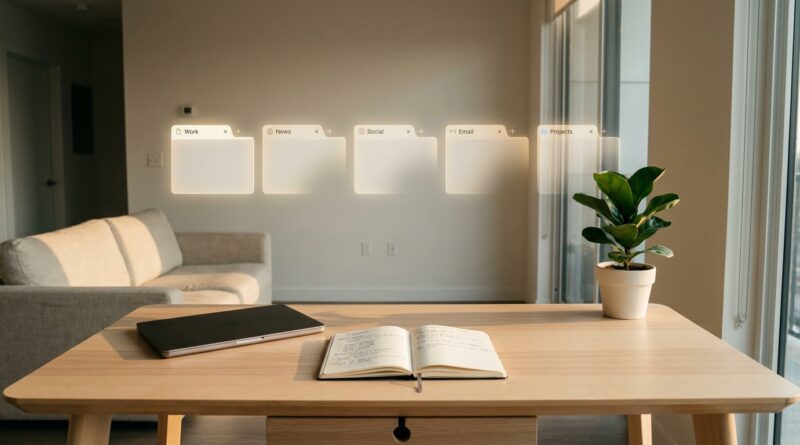
The 5‑Tab Brain: A Minimalist Way To Stop ‘Background Thinking’ From Burning You Out
You shut the laptop. You put the phone face down. You even clear your desktop. But somehow your brain still sounds like a browser with 37 tabs open. One tab is a bill you need to pay. One is that text you forgot to answer. Another is a half-baked idea that keeps tapping you on the shoulder while you are trying to rest. It is exhausting, and it can make you feel like you are bad at focusing when the real problem is simpler than that. Your mind is carrying too many open loops at once. That is not laziness. It is mental overload. A lot of people chasing digital minimalism miss this part. You can clean up your devices and still feel mentally crowded. The fix is not a perfect meditation routine or a total life reset. It is a tiny shutdown habit. Think of it as mental decluttering for productivity, done in five tabs, in under ten minutes.
⚡ In a Hurry? Key Takeaways
- The fastest way to calm background thinking is to close mental loops with a simple five-step ritual, not just by deleting apps.
- Write down open tasks, sort them into a few buckets, choose one next step, set one worry boundary, and end with a short reset.
- This is not about doing more. It is about freeing up working memory so your brain stops using energy to remember everything at once.
Why your brain still feels busy when your screen is clean
Most of us have been taught to treat distraction like a tech problem. Too many notifications. Too many apps. Too much screen time.
Sometimes that is true. But often the real drain is unfinished thinking.
Your brain keeps reopening items it thinks are important. That is why random thoughts pop up in the shower, during dinner, or right as your head hits the pillow. The mind hates loose ends. If it does not trust that something has been captured, it keeps bringing it back.
This is where mental decluttering for productivity matters. You are not trying to become an empty-headed zen master. You are trying to stop your brain from acting like a sticky note wall with no off switch.
The 5-Tab Brain method
The goal is simple. Give every open loop a place to go, so your mind does not have to keep holding it.
You can do this at the end of the workday, before bed, or anytime you feel mentally jammed up. Set a timer for ten minutes. That limit matters. This should feel light, not like homework.
Tab 1. Dump everything out
Grab paper or open a plain note. Spend two minutes writing every nagging thought you can think of.
Not full plans. Just quick captures.
Examples:
Send invoice. Book dentist. Ask Sam about Friday. Fix that weird kitchen light. Idea for side project. Look up that subscription charge.
Do not sort while you write. Just empty the pockets of your mind.
Tab 2. Sort into five buckets
Now give each item one simple home. Use these five buckets:
- Do today. Small things that truly need action soon.
- Do later. Important, but not now.
- Waiting. Things someone else needs to reply to or finish.
- Worry. Stuff you cannot solve right this minute.
- Drop. Things that felt urgent in your head but do not deserve more energy.
This step is more powerful than it looks. A lot of mental fatigue comes from treating every thought like it has the same priority. It does not.
Tab 3. Pick one next step for each real task
“Taxes” is not a next step. “Find tax folder” is.
“Kitchen light” is vague. “Order replacement bulb” is clear.
Your brain relaxes when it sees a starting point. Vague tasks create friction. Concrete tasks lower it.
If you only do one thing from this whole method, do this one.
Tab 4. Put a boundary around worries
This is the tab many people skip. Then they wonder why they still feel tense.
Some thoughts are not tasks. They are worries. Health worries. Money worries. Parenting worries. Social worries. If you treat them like to-do items, they just grow teeth.
Instead, give each worry one boundary:
- Can I act on this now?
- If yes, what is the next step?
- If no, when will I revisit it?
That revisit point might be “Saturday at 10 a.m.” or “when I talk to my manager tomorrow.” The point is to stop carrying it all day like a buzzing alarm.
Tab 5. End with a small reset signal
Close the ritual with something physical and short. Stand up. Take five slow breaths. Clear your desk. Wash the mug. Shut the notebook.
This tells your brain, “We are done holding this for now.”
If your space is part of the mental noise, pair this step with The 5‑Object Rule: A Minimalist Daily Reset To Clear Your Head In Under 10 Minutes. It is a nice match because physical clutter and mental clutter like to team up.
What this ritual actually fixes
This method will not erase every stressor in your life. But it does reduce a very specific kind of exhaustion.
It cuts background processing
When your brain trusts that open loops have been captured and sorted, it stops pinging you as often. That means fewer random reminders while you are trying to focus.
It lowers fake urgency
Some thoughts feel urgent only because they are floating around with nowhere to land. Once written down, many shrink to normal size.
It makes focus easier
Focus is not always about more discipline. Sometimes it is just about fewer open loops competing for attention.
It helps you rest without guilt
Rest is hard when your brain is afraid it will forget something important. A trusted shutdown ritual gives your mind permission to stop scanning.
Common mistakes that make mental decluttering fail
Trying to organize your whole life at once
Do not turn a ten-minute reset into a two-hour personal retreat. You are not building a perfect system. You are closing tabs.
Keeping everything in your head after the dump
If you write a list and then never look at it again, your brain will not trust the system. Put the real tasks into your calendar, reminders, or task app.
Confusing worries with responsibilities
You are responsible for actions. You are not required to mentally rehearse every possible bad outcome all day long.
Using too many tools
A notebook, one notes app, or one task app is enough. The more places you scatter your thoughts, the more tabs you create.
A simple example of the 5-Tab Brain in real life
Let us say your brain is chewing on these seven things:
- Email the landlord
- Buy a birthday gift
- Figure out why the bank charge looks odd
- Wondering if your boss was annoyed in that meeting
- Return library books
- Plan summer trip
- Start getting healthier
After the ritual, it might look like this:
- Do today: Email landlord. Return library books.
- Do later: Buy birthday gift on Thursday. Plan summer trip next Sunday.
- Waiting: Bank charge, call bank tomorrow at lunch.
- Worry: Ask boss for feedback in Friday one-to-one, instead of replaying the meeting all night.
- Drop or shrink: “Start getting healthier” becomes “Walk 15 minutes tomorrow.”
Same life. Less mental drag.
How to make the habit stick
Attach it to something you already do.
After shutting your laptop. After dinner. Before brushing your teeth. Keep it boring and repeatable.
You do not need to feel inspired. You just need a reliable off-ramp for the day.
If evenings are your most restless time, that is probably the best place to start. The ritual works especially well before bed because nighttime is when unattended thoughts love to get loud.
At a Glance: Comparison
| Feature/Aspect | Details | Verdict |
|---|---|---|
| Speed | Takes about 5 to 10 minutes and works with paper or a basic notes app. | Easy to do daily |
| Best use | Helps when you feel mentally crowded, distracted, or unable to switch off after work. | Highly practical |
| What it does not do | It will not solve deep stress on its own, but it does reduce mental noise and forgotten-task anxiety. | Best as a daily support habit |
Conclusion
Digital minimalism gets a lot of attention, but too much of the advice stops at cleaning up your phone or deleting a few apps. That helps, sure. But the bigger drain for many people is the mess you cannot see. The half-finished thoughts, tiny worries, and mental reminders that keep running in the background. That is why this five-step close-down ritual matters. It turns a fuzzy idea like mindfulness into something concrete you can actually use. In less than ten minutes, you can free up working memory, calm that low-grade anxiety, and make it much easier to focus or rest. You do not need a total life overhaul. You just need a simple way to close a few mental tabs before they burn through your energy.