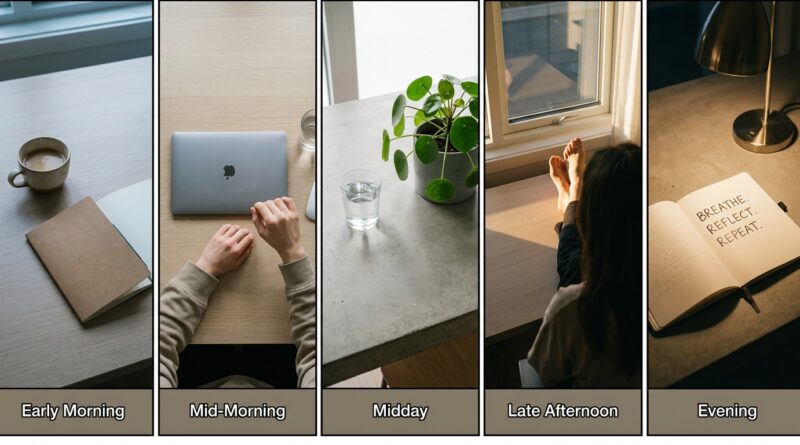
The 5‑Pause Day: A Minimalist Reset Ritual To Stop Burnout Before It Starts
You are not lazy, broken, or bad at time management if your day ends with that odd mix of exhaustion and restlessness. A lot of people are pushing through packed calendars, constant pings, and back-to-back context switching, then wondering why they feel fried by 6 p.m. and still cannot fully relax. The problem is not always workload. Often, it is the lack of any real pause while the workload is happening. Your brain never gets a clean breath.
That is where minimalist micro breaks for burnout can help. Not a perfect morning routine. Not a new app with streaks and badges. Just five small pauses, placed on purpose, to cool the system before it overheats. Think of it like restarting a browser tab before the whole laptop locks up. Short, simple, and realistic. If you have two minutes between meetings or while your coffee heats up, you already have enough time to start.
⚡ In a Hurry? Key Takeaways
- A five-pause day uses brief, intentional breaks to reduce mental overload before burnout builds up.
- Start with five pauses of 1 to 5 minutes tied to moments you already have, like before email, after meetings, and before dinner.
- This is not about doing less work. It is about protecting attention, lowering stress, and using spare minutes instead of losing them to doomscrolling.
Why burnout often starts long before you notice it
Burnout rarely arrives in one dramatic moment. It sneaks in through tiny things. Too many tabs open. Too many notifications. No transition between tasks. Lunch eaten while answering messages. A brain that is always “on,” even when your body is sitting still.
That matters because your mind is not built for nonstop switching. Every time you jump from a spreadsheet to Slack to a meeting to email, there is a cost. Attention gets chopped up. Stress hormones stay elevated. By the end of the day, you can feel both drained and oddly buzzy.
This is why minimalist micro breaks for burnout are getting so much attention. They are small enough to be realistic, but useful enough to make a real dent in how your day feels.
What the 5-Pause Day actually is
The 5-Pause Day is a simple reset ritual. You take five intentional pauses during the day. Not long ones. Most are between one and five minutes. Each pause has a job.
- Pause 1 calms the start.
- Pause 2 resets after your first work sprint.
- Pause 3 creates a true midday break.
- Pause 4 clears the fog in the afternoon slump.
- Pause 5 helps your brain leave work behind.
That is it. No tracking dashboard required. No color-coded productivity map. Just five checkpoints that stop your day from turning into one long blur.
The 5 pauses, step by step
Pause 1: The arrival pause
When: Before you open email, Slack, or your first task.
How long: 1 to 2 minutes.
What to do: Sit down. Put both feet on the floor. Take five slow breaths. Ask, “What actually needs my attention first?” Then pick one priority.
This sounds tiny because it is tiny. But it helps you start the day instead of getting instantly hijacked by other people’s urgency.
Pause 2: The post-sprint reset
When: After 60 to 90 minutes of focused work, or after your first meeting block.
How long: 2 to 3 minutes.
What to do: Stand up. Stretch your shoulders. Look away from the screen. If possible, look at something far away, like a window or down a hallway. Take a few deeper breaths.
This pause helps your eyes, posture, and attention recover. It also gives your brain a clean break before the next task starts.
Pause 3: The real lunch pause
When: Midday.
How long: 5 minutes minimum, longer if you can.
What to do: Step away from your work area. Eat without scrolling if possible. If you cannot take a full lunch, at least get up, drink water, and let your brain stop processing inputs for a few minutes.
The key word here is real. A lunch break while checking messages is not much of a break.
Pause 4: The afternoon circuit breaker
When: Around the point where your focus gets fuzzy, often 2 to 4 p.m.
How long: 2 to 5 minutes.
What to do: Walk to another room. Refill water. Do ten slow breaths. Write down the next one or two tasks only. Not ten. Two.
This pause is there to stop the classic afternoon spiral where you are tired, overstimulated, and suddenly checking your phone every four minutes.
Pause 5: The shutdown pause
When: At the end of your workday.
How long: 3 to 5 minutes.
What to do: Write down what you finished, what is next, and one thing that can wait until tomorrow. Then close the laptop or leave the workspace.
This is the pause many people skip. It is also one of the most useful. Without some kind of shutdown, work keeps running in the background of your mind all evening.
Why this works better than another complicated system
Most people do not need more productivity machinery. They need less friction. The beauty of a five-pause framework is that it works with the day you already have.
You do not have to “find” 45 extra minutes. You just reclaim scattered little windows that usually disappear into reflex scrolling, inbox refreshing, or staring at the screen while too tired to think clearly.
Research on micro-breaks has pointed in a pretty practical direction. Short breaks can support focus, reduce fatigue, and improve how people feel during the workday, especially when those breaks include movement, breathing, or a mental shift away from the task. The break does not need to be dramatic. It just needs to be real.
What counts as a good micro break
Not every pause does the same thing. If your “break” is opening another app and feeding your brain more noise, it may not help much.
Good minimalist micro breaks for burnout usually include one or more of these:
- Movement, even gentle stretching or a short walk
- Eye relief from screens
- Slow breathing
- Water or a snack
- Quiet with no fresh input
- A quick brain dump onto paper
Bad breaks are not evil. They are just less restorative. Mindless scrolling often keeps the stimulation going when what you really need is a little less stimulation.
How to make the five pauses stick
Tie each pause to something that already happens
Habits are easier when they are attached to existing moments. For example:
- Before opening your inbox
- Right after a recurring meeting ends
- When you heat lunch
- At the 3 p.m. slump
- Before shutting your laptop
Make the pause obvious
Put a sticky note on your monitor that says “Breathe first” or “Stand up now.” Set a gentle phone reminder if needed. Use low-tech cues. They work.
Do not try to make every pause perfect
Some days, your afternoon pause will be a peaceful walk. Other days, it will be 90 seconds of staring out the window while muting notifications. Both count.
What if your schedule is brutal?
Then go smaller, not bigger. If your day is jammed, a one-minute pause is still a pause. Burnout prevention is not an all-or-nothing sport.
Try this emergency version:
- Three breaths before a meeting
- Stand up once every two hours
- Drink water before checking social media
- Write tomorrow’s first task before ending work
If that is all you can manage this week, start there. Small done consistently beats ambitious and abandoned.
Common mistakes people make
Turning breaks into another thing to optimize
The goal is relief, not performance theater. You do not need the perfect timer, playlist, or breathing pattern.
Using breaks only when you are already fried
These pauses work best as prevention. Think maintenance, not rescue.
Confusing distraction with recovery
A break that leaves you more scattered is probably not doing the job. Recovery should make you feel a little clearer, steadier, or less tense.
A simple one-day example
Here is what a normal workday might look like with the five-pause rhythm:
- 8:55 a.m. Sit down, breathe, pick one priority.
- 10:30 a.m. Stand, stretch, look away from the screen for two minutes.
- 12:45 p.m. Eat away from your desk, no inbox.
- 3:15 p.m. Walk to refill water, list the next two tasks.
- 5:30 p.m. Write tomorrow’s first step, shut down.
Nothing fancy. But done daily, this can make your work feel less like a constant electrical hum.
At a Glance: Comparison
| Feature/Aspect | Details | Verdict |
|---|---|---|
| Time required | Five pauses spread across the day, usually 1 to 5 minutes each | Low effort and realistic for most schedules |
| Tools needed | None beyond a clock, sticky note, or basic reminder | Better than adding another app you will ignore |
| Main benefit | Less mental overheating, smoother transitions, easier end-of-day shutdown | Strong everyday burnout prevention habit |
Conclusion
You do not have to win a battle against your calendar every day to feel okay. Sometimes the smarter move is simpler. Short, research-backed micro-breaks and intentional pauses are trending hard right now because people are finally admitting they cannot brute-force their way through constant notifications, meetings, and context-switching anymore. A simple five-pause framework gives our community a practical, minimalist way to protect their brain in real time, using something they actually have today: scattered pockets of a few minutes that usually get lost to scrolling. Start with one pause tomorrow. Then add the rest. Your brain does not need a makeover. It probably just needs a minute.