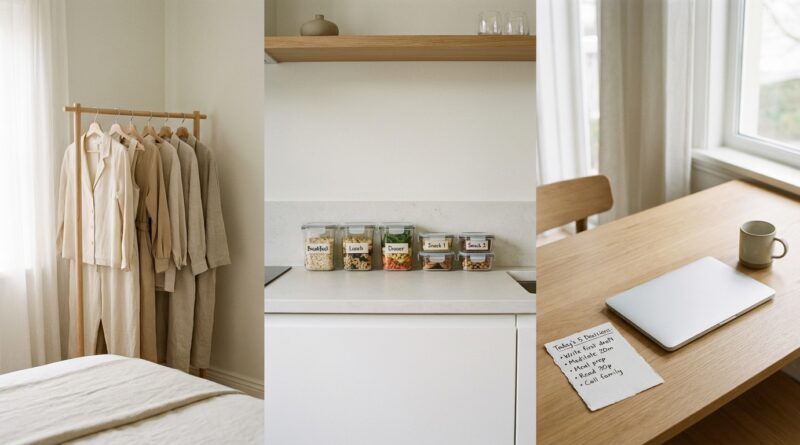
The 5-Decision Day: A Minimalist Way To Beat Mental Exhaustion And Get More Done
You are probably not lazy, unmotivated, or “bad at focus.” You are likely just worn down by too many tiny choices. What to wear. What to eat. Which message to answer first. Whether to keep working or quickly check that one notification. None of these feels huge on its own, but together they can drain your attention before the day has properly started. That is decision fatigue, and it sneaks up on people who are otherwise doing everything right. They cleaned up their desk, trimmed their apps, maybe even bought a planner, yet they still feel mentally flat by noon. The fix is not always better organization. Sometimes it is fewer choices. The 5-Decision Day is a simple, minimalist productivity system built around five pre-decisions. You make them once, ahead of time, then stop spending energy on them all day.
⚡ In a Hurry? Key Takeaways
- The 5-Decision Day cuts mental drain by removing five repeat choices before the day starts.
- Pre-decide your clothes, meals, communication windows, work blocks, and evening shutdown for just one day.
- This costs nothing, needs no new app, and works best as a low-pressure experiment, not a strict life overhaul.
Why your brain feels tired so early
Most people think exhaustion comes from having too much to do. Sometimes that is true. But often the real problem is having too much to decide.
Your brain burns energy every time it has to choose, sort, compare, switch, or second-guess. Tiny decisions count too. In fact, they are often worse because they arrive nonstop and barely register. You do not feel like you are making 100 choices. You just feel oddly worn out.
That is why a day can feel heavy even when nothing dramatic happened. Your focus leaked out in little drops.
What is the 5-Decision Day?
The 5-Decision Day is a one-day reset. You pick five areas that usually create a lot of mental friction, then you make those decisions in advance. Once the day starts, you follow the script instead of renegotiating with yourself every hour.
This is not about becoming robotic. It is about saving your best brainpower for work, people, and problems that actually matter.
The five pre-decisions are simple:
- What you will wear
- What you will eat
- When you will check messages
- When you will do focused work
- How you will end the day
Why this minimalist productivity system works
Most productivity advice adds a layer. Another app. Another dashboard. Another reminder system. That can help, but it can also create more maintenance. More settings. More choices.
A good decision fatigue minimalist productivity system does the opposite. It removes options you do not need. It cuts down on repeated internal debates. It gives your day a few rails to run on.
If this sounds familiar, it fits nicely with the idea behind The 5‑Threshold Rule: A Minimalist Way To Protect Your Best Hours From Modern Life’s Constant Creep. Better boundaries often beat better tools.
The five pre-decisions to make tonight
1. Clothing: wear the obvious thing
Pick tomorrow’s outfit tonight. Not three options. One.
This sounds small, but it removes a silly amount of friction. You avoid the morning weather debate, the “does this look right?” pause, and the rummaging that starts the day in a mild panic.
Keep it boring if you want. In fact, boring is good here. The point is not style. The point is saving mental fuel.
2. Food: decide your default meals
Choose breakfast, lunch, and one easy snack ahead of time. If tomorrow is busy, make the decision even simpler. Repeat a meal you already know works.
You do not need a meal-prep channel and a color-coded diet spreadsheet. You just need less wobbling at 11:45 when your brain is already fading.
Good examples:
- Breakfast: yogurt and fruit
- Lunch: sandwich and soup
- Snack: nuts or a banana
It is amazing how much energy disappears into “What should I eat?” and “Should I order something?”
3. Communication: set message windows
This is a big one. Decide when you will check email, texts, Slack, or whatever pings at you all day.
Try two or three windows instead of constant grazing. For example:
- 10:30 a.m.
- 1:30 p.m.
- 4:30 p.m.
Outside those times, leave it alone unless it is truly urgent. Most messages are not emergencies. They just arrive dressed like one.
This single change can make your day feel quieter almost immediately.
4. Work blocks: choose your focus slots in advance
Do not wake up and ask, “What should I work on first?” That question is more tiring than it seems. Decide tonight what your first one or two work blocks are for.
Be specific:
- 9:00 to 10:30, finish draft
- 11:00 to 12:00, review budget
Notice what is missing. No giant to-do list. No elaborate system. Just a clear next move.
If your days keep getting eaten by drift, meetings, and random digital clutter, this is where a boundary-based approach helps. That is why The 5‑Threshold Rule: A Minimalist Way To Protect Your Best Hours From Modern Life’s Constant Creep pairs so well with this idea. Protect the hours first. Then reduce the decisions inside them.
5. Evening wind-down: decide how the day ends
Many people use up their last bit of brainpower deciding whether to keep going, scroll, snack, start another task, or finally rest.
Make that decision early. Pick a simple shutdown routine for tonight, before tomorrow begins.
For example:
- 8:30 p.m. screens off
- Lay out clothes
- Write top two tasks for tomorrow
- Read for 20 minutes
This helps in two ways. It saves energy at night, and it makes the next morning easier before it even starts.
How to run the one-day experiment
Do this for one day only. That matters.
If you treat it like a life overhaul, you will probably overbuild it and quit. If you treat it like an experiment, you will actually try it.
Tonight, write down your five pre-decisions on paper or in a notes app. Keep them short. Tomorrow, follow them as closely as real life allows. No guilt if something changes. The goal is not perfection. The goal is noticing how much lighter your day feels when fewer choices are chasing you.
What to expect by noon
Do not expect magic. Expect relief.
You may notice:
- Less stalling in the morning
- Fewer random phone checks
- More energy for actual work
- Less “Why am I so tired already?”
That last one is the big clue. When decision fatigue drops, the day often feels less noisy inside your head.
Common mistakes to avoid
Making too many pre-decisions
Stick to five. Not fifteen. If you try to script your entire life, you will create a new kind of stress.
Picking unrealistic rules
Do not choose meals you will not eat or work blocks your schedule cannot support. Simple beats impressive.
Using this to punish yourself
This is not about control for its own sake. It is about reducing friction. If your plan makes the day feel tighter and meaner, it is the wrong plan.
Thinking you need an app
You really do not. A sticky note works. So does a scrap of paper. This method is useful because it is light.
Who this helps most
This works especially well for people who already decluttered a lot and still feel mentally overloaded. Your desk may be clean. Your phone may be tidier. But if your day is still full of tiny choices, your brain never gets a break.
That is the gap this method fills. It goes beyond cleaning up stuff and screens. It trims the invisible clutter of constant deciding.
At a Glance: Comparison
| Feature/Aspect | Details | Verdict |
|---|---|---|
| Setup effort | Takes about 10 minutes the night before to pre-decide five repeat choices. | Low effort, high return |
| Tools needed | No app, subscription, or gadget required. Paper is enough. | Excellent for minimalists |
| Best benefit | Reduces mental drain from micro decisions around clothing, food, messages, work, and shutdown. | Strong same-day payoff |
Conclusion
Decision fatigue is one of those problems that hides in plain sight. You can have a cleaner desk, a tidier phone, and a decent routine, yet still feel cooked by midday because your brain has been busy making tiny choices nonstop. The 5-Decision Day is useful because it does not ask you to buy anything, learn a complicated system, or hand your life over to another app. It simply asks you to remove five unnecessary decisions for one day and feel the difference. Pre-decide your clothes, food, communication windows, work blocks, and evening wind-down. That is it. For the 5J crowd, it is a practical experiment you can run today, and it adds a fresh layer to minimalist living that goes beyond screens and feeds. Sometimes getting more done starts with deciding less.