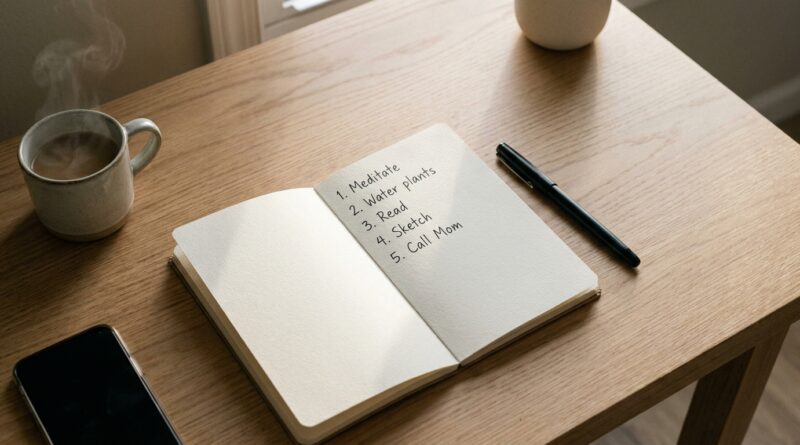
The 5‑Task Day: A Minimalist Way To Stop Treating Your Life Like An Endless To‑Do List
You are probably not failing at life. You are probably drowning in a list that was never meant to be finished. That is the real problem for a lot of people right now. Every small task, message, errand, reminder and half-finished idea lands in the same mental pile. By 8 p.m., you are wiped out, your brain feels noisy, and somehow the list is still longer than it was this morning. That kind of exhaustion does not mean you are lazy. It means your days have turned into a sorting machine for everyone else’s priorities. A five-task day is a simple reset. You pick five things that count for today, no more. Not fifty. Not “everything if I push harder.” Just five. It is a slow productivity minimalist task list approach that helps you stop measuring your worth by how busy you looked, and start measuring your day by what actually mattered.
⚡ In a Hurry? Key Takeaways
- A five-task day means choosing only five meaningful tasks for today, so your list matches your real time and energy.
- Write your five tasks before the day gets noisy, then keep everything else on a separate parking lot list.
- This is not about doing less forever. It is about protecting attention, reducing burnout, and making your workload honest.
Why your to-do list keeps making you feel behind
Most to-do lists have one big flaw. They mix everything together.
Important work. Tiny errands. Long-term goals. Other people’s requests. Stuff you might do someday. Stuff you forgot last week. It all sits there in one giant pile, pretending to have equal weight.
Your brain sees that pile and does not think, “Nice, a useful system.” It thinks, “I am in trouble.”
That is why a normal list can make you feel busy before you have even started. It is not just a planning tool. It becomes a guilt machine.
A slow productivity minimalist task list works differently. It accepts a basic truth that many systems ignore. Your day is limited. Your energy is limited. Your attention is limited. So your list should be limited too.
What the 5-task day actually is
The rule is simple. For one day, you choose five tasks. That is your whole active list.
Those five tasks can be work tasks, home tasks, life admin, or personal care. The point is not to create a perfect category system. The point is to make the day real.
What counts as a task?
A task should be clear and doable.
Good examples:
- Send the invoice
- Book the dentist appointment
- Finish the first draft of the report
- Take a 20-minute walk
- Do one load of laundry
Less helpful examples:
- Fix my life
- Get organized
- Handle work
- Be productive all day
If a task is huge, shrink it. “Finish taxes” might become “gather tax documents for 30 minutes.” That still counts.
Why five?
Because five is enough to make progress, but small enough to force honesty.
Ten tasks still leaves too much room for fantasy planning. Three tasks can work too, especially in a stressful season. But five is a sweet spot for many people. It gives your day structure without turning it into a punishment.
The hidden benefit: it separates intention from inventory
This is the part that changes everything.
You can still keep a master list. In fact, you probably should. That master list is your inventory. It holds errands, ideas, future tasks and reminders.
But your five-task list is not inventory. It is intention.
That difference matters. A long master list can exist without crushing your day, as long as it is not the thing you stare at every hour.
Think of it like your phone storage. You may have thousands of photos saved, but you do not need all of them open on the screen at once. Your brain works the same way.
How to start tomorrow morning
You do not need a new app. A sticky note is enough.
Step 1: Make one long parking lot list
Put all the loose tasks in one place. Paper, notes app, whatever you already use.
This is where the overflow lives. It is not today’s list.
Step 2: Choose five tasks for today
Look at your real schedule. Meetings, childcare, commute, energy level, appointments, all of it.
Then pick five tasks that fit in the actual day you have, not the imaginary day where nothing goes wrong and you suddenly become a productivity robot.
Step 3: Pick in this order
- One important task that moves life or work forward
- Two medium tasks that reduce pressure
- One small admin task
- One task that cares for you or your home
This keeps the list balanced. It stops the day from being swallowed by only urgent or only boring tasks.
Step 4: Finish, then stop adding
This is the hard part. When a new task pops up, do not automatically turn it into task number six. Put it in the parking lot list unless it is truly urgent.
The five-task day only works if the limit means something.
What if your job throws new tasks at you all day?
That is a fair question. Some people do not control their day very much.
If your work is reactive, customer support, caregiving, management, teaching, operations, then use the method a little differently.
Instead of five exact tasks, choose five outcomes or priorities.
For example:
- Clear urgent client emails by noon
- Finish payroll review
- Call back three parents
- Restock supplies
- Take lunch away from the desk
You are still capping the day. You are still deciding what counts. That is the point.
Why this feels so strange at first
Because many of us were trained to treat overload as normal.
A packed list can feel responsible. A short list can feel lazy. But those feelings are not always telling the truth.
A long list often just hides bad planning, fuzzy priorities, or a habit of saying yes to everything.
A shorter list asks a harder question. What actually matters today?
That question can be uncomfortable. It also tends to be useful.
Common mistakes with the 5-task day
1. Picking five huge tasks
If all five tasks are monsters, the system will fail by lunch.
Mix big and small. Your list should feel focused, not doomed.
2. Using tiny filler tasks to feel productive
“Reply to one text” should not take up one of your precious five slots unless that text really matters.
Do not game the system. Use it to tell the truth.
3. Rewriting the list all day
If you keep changing the five tasks every time your mood changes, you are not prioritizing. You are chasing relief.
Set the list, then work the list.
4. Forgetting rest and maintenance tasks
Eat lunch. Take your meds. Go outside. Pay the bill. Fold the clothes.
Minimalist productivity is not just about output. It is also about making life run without frying your nervous system.
How this fits with a minimalist lifestyle
Minimalism is not only about owning fewer things. It is also about carrying less mental clutter.
The five-task day does exactly that. It cuts visual clutter, decision clutter and guilt clutter.
Instead of performing busyness, you are choosing a few things on purpose.
If your mornings already feel chaotic, pairing this with a calming setup can help. A simple routine like The 5‑Signal Morning: A Minimalist Routine That Calms Your Brain Before The Day Attacks You can make it much easier to pick your five tasks before notifications and stress take over.
What happened when people try this for a week
The first surprise is usually relief.
The second is resistance.
Relief comes from finally seeing a day-sized list. Resistance shows up when unfinished things still exist in the background. That is normal. The goal is not to erase all demands from your life in seven days. The goal is to stop dragging all of them through every hour.
After a few days, many people notice three shifts:
- They choose tasks more carefully
- They finish more of what they start
- They feel less fake-busy and more genuinely done
That last one matters. “Done for today” is a feeling a lot of people have not had in a long time.
When to break the rule
Yes, there are exceptions.
If there is an emergency, a deadline crisis, a sick kid, a broken car, or a day where life clearly does not care about your tidy system, adapt.
The five-task day is a tool, not a religion.
But do not call everything an emergency. That is how the endless list sneaks back in.
A simple template you can copy
Try this:
- Task 1: One thing that matters most
- Task 2: One thing that reduces stress
- Task 3: One thing that keeps work or home moving
- Task 4: One small admin task
- Task 5: One thing that supports your body, home or peace of mind
That is it. You can write it on paper in less than a minute.
At a Glance: Comparison
| Feature/Aspect | Details | Verdict |
|---|---|---|
| Daily task limit | Caps your active list at five meaningful tasks, with everything else kept in a separate parking lot list. | Best for reducing overwhelm fast. |
| Ease of setup | Needs only paper or a notes app. No special system, subscription or color-coded dashboard required. | Very easy to try tomorrow. |
| Mental health impact | Helps your brain see a finish line, lowers guilt, and makes your workload look more honest. | Strong value if you feel constantly behind. |
Conclusion
The nice thing about the five-task day is how unglamorous it is. No app. No life overhaul. No pretend-perfect routine. Just a simple limit that brings your day back down to human size. Right now the internet is full of talk about slow productivity, burnout and the end of hustle culture, but very few people are offering something you can actually try tomorrow morning without buying another app or building a complex system. A simple five-task cap fits perfectly with a minimalist lifestyle, cuts through performative busyness, and helps protect your energy, attention and mental health in a week where everyone is being asked to do more with less. If your list has been running your life, this is a small, practical way to take some of it back.