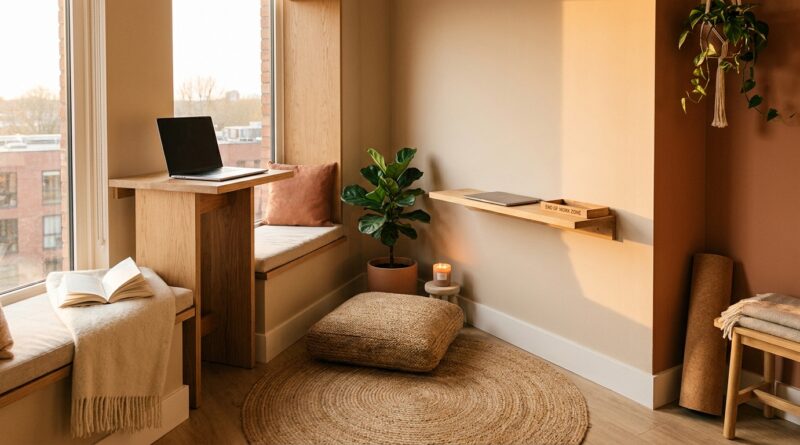
The 5‑Nook Home: A Minimalist Way To Turn Tiny Corners Into Deep‑Focus Power Spots
Your home can start to feel like a browser with 37 tabs open. The couch is for scrolling and guilt. The kitchen table is a desk until dinner. A yoga mat lives in the hallway like an apology. If you live in a small apartment, shared place, or busy family home, that scattered feeling is real. You are not bad at focus. Your space is just asking one room to do too many jobs at once.
The fix is surprisingly simple. Stop trying to make one perfect multipurpose room. Start making a few tiny, single-purpose spots instead. Think of them as focus cues for your brain. A chair by a lamp becomes your reading nook. One end of a counter becomes your admin station. A cleared wall becomes your stretch zone. These minimalist small home focus nooks do not need expensive furniture or a renovation. They just need a clear job. Once each corner knows what it is for, your brain wastes less energy switching gears, and daily life starts to feel calmer, lighter, and easier to handle.
⚡ In a Hurry? Key Takeaways
- Small homes work better when you create five tiny zones with one job each, instead of one room doing everything badly.
- Start with corners you already have, like a window ledge, wall section, bedside area, chair, or end of a table. Add only what supports that one activity.
- You do not need to buy much. The real value comes from visual boundaries, fewer objects, and repeating the same activity in the same spot.
Why small nooks work better than one overworked room
When everything happens everywhere, your brain never gets a clean signal. Work bleeds into rest. Rest gets interrupted by chores. Even fun starts to feel messy because there is no off switch.
This is why minimalist small home focus nooks are catching on. They are less about interior design trends and more about mental load. A small zone with one clear purpose asks less of you. You sit there, and your brain starts to know what happens next.
That matters more than square footage. A 24-inch shelf used only for planning can beat a big dining table covered in random stuff. A tiny floor patch used only for stretching can feel more calming than a whole room that also stores laundry and unopened boxes.
The 5-nook home idea
You do not need five extra rooms. You need five tiny identities inside the space you already have. Each nook should answer one question: “What do I do here?” If the answer is more than one thing, make it simpler.
1. The deep-focus nook
This is your work or study spot. Not your whole office fantasy. Just the smallest place where you can do concentrated thinking.
It might be:
- A narrow desk against a wall
- A folding table near a window
- A wall-mounted shelf with a stool
- One end of a dining table with a tray for your gear
Keep only the essentials here. Laptop. Charger. Notebook. Light. Maybe headphones. That is it. If this nook starts collecting mail, snacks, and half-finished projects, it stops being a focus spot and becomes another stress pile.
A good rule is this. If you would not need it during 45 minutes of focused work, it does not belong there.
2. The quick-admin nook
This is for life maintenance. Paying bills. Answering email. Checking the calendar. Signing school forms. Ordering dog food. Tiny tasks love to spread across the whole house if you let them.
Your admin nook can be very small. A basket, a charger, a pen cup, and a seat are enough. You might use a corner of a console table or a kitchen counter section that is not also your chopping area.
The point is to stop low-level tasks from invading your deep-focus nook. Different jobs. Different spots.
3. The recovery nook
Most small homes have a sitting area, but not all sitting areas feel restful. If your couch is also where you doomscroll, snack, work, and fold laundry, it is not really helping you recover.
A recovery nook should feel quieter on purpose. Think one chair, one blanket, one lamp, one side table, one book. Maybe a candle if that is your thing. Maybe soft music. No laptop charger in sight.
This nook tells your nervous system, “You do not need to perform here.” That message is worth a lot.
4. The movement nook
You do not need a home gym. You need enough clear floor to move without resentment. A yoga mat rolled beside a wall. Resistance bands on a hook. A pair of dumbbells under a bench. Done.
If possible, keep this nook visible and ready. Hidden gear often becomes unused gear. The goal is to reduce friction so movement feels easy to start.
This spot can also double as a posture reset area during the day. Two minutes of stretching in a dedicated zone counts. It still trains your brain to shift out of desk mode.
5. The landing nook
This one is easy to overlook, but it saves the rest of the system. Your landing nook is where keys, bag, shoes, water bottle, receipts, and daily clutter first arrive.
Without it, every other nook gets polluted. Suddenly your focus shelf is holding grocery bags, and your recovery chair is wearing a jacket.
You only need a hook, tray, small bin, or narrow shelf near the door. If you do not have an entryway, fake one. A corner by the door counts.
How to set up each nook without spending much
The best version of this idea is not expensive. It is edited.
Use visual boundaries
Your brain notices edges. Use a rug, lamp, shelf, plant, wall hook, tray, or even painter’s tape inside a drawer. You are not building walls. You are giving each area a shape.
Give each nook a “starter kit”
Make it easy to begin the activity linked to that space.
- Focus nook: laptop stand, notebook, charger
- Admin nook: mail tray, pen, charger, planner
- Recovery nook: blanket, book, tea coaster
- Movement nook: mat, band, water bottle
- Landing nook: hooks, tray, basket
Do not mix emotional jobs
This is a big one. Try not to put stressful tasks and relaxing tasks in the same exact spot. If you answer work email from bed, your bed starts to feel like work. If you pay bills in your reading chair, your reading chair loses some of its calm.
Make the right thing the easy thing
If your deep-focus nook needs five minutes of clearing before you can sit down, it is not ready. If your stretch area requires moving three chairs, you will skip it. Friction matters.
What to remove so the nooks actually stay useful
Sometimes the real design move is subtraction. Tiny homes and small apartments get crowded fast because every object starts asking for attention.
As you build your minimalist small home focus nooks, remove:
- Furniture that has no clear job
- Decor that blocks surfaces you actually need
- Cables with no home
- Overflow storage that has turned into permanent clutter
- Items that belong in another room but migrated
A nook should feel a little empty. That is not a mistake. Empty space is what lets your mind settle.
Common mistakes that make small spaces feel worse
Trying to make every nook Instagram-perfect
Pretty helps, sure. But function comes first. If a folding chair by good light helps you write, that counts.
Assigning too many purposes to one corner
If your “wellness nook” is also your office, vanity, and laundry fold station, it is not a nook. It is just a small pile with ambitions.
Buying organizers before deciding behavior
Storage products are not the plan. The plan is deciding what happens where. Buy containers after that.
Ignoring household traffic
Do not put your focus nook where everyone passes every three minutes if you can help it. Use calmer edges of the room for concentration, and busier edges for landing or admin tasks.
A simple weekend plan to build your 5-nook home
If this feels like a lot, do it in one pass.
Step 1. Walk your home slowly
Look for underused spots. Window corners. Blank wall sections. The side of the bed. The end of the sofa. The stretch beside a bookshelf. Tiny homes always have more possible zones than you think.
Step 2. Match each spot to one behavior
Ask what your life needs most right now. More focus. Better rest. Easier exercise. Less clutter at the door. Pick the behavior first, then the spot.
Step 3. Add only the minimum tools
One surface. One seat if needed. One light. One container. Start small.
Step 4. Test for one week
Do not lock yourself into the first layout. If the admin nook works better near the charger, move it. If the recovery nook needs warmer light, swap the lamp.
Step 5. Protect the identity of each nook
This is where the magic happens. Keep saying no when random stuff tries to move in.
Why this helps with focus, even if you are not a “design person”
You do not need to care about decor to benefit from this. You just need fewer decisions. That is the real win.
When your home has tiny, intentional pockets of use, you spend less time asking yourself where to sit, where to put things, and how to start. The space answers for you. That lowers friction. It also lowers the vague stress that comes from being surrounded by mixed signals all day.
And unlike a full makeover, this approach respects real life. Renters can do it. Parents can do it. People in studio apartments can do it. People sharing a kitchen table can do it.
At a Glance: Comparison
| Feature/Aspect | Details | Verdict |
|---|---|---|
| One big multipurpose room | Everything happens in the same area, so work, rest, chores, and exercise blend together. | Convenient at first, but mentally tiring over time. |
| Five small purpose-based nooks | Tiny corners get one clear role each, like focus, admin, recovery, movement, and landing. | Best for calm, consistency, and easier transitions. |
| Cost and effort | Usually uses furniture and surfaces you already own, with a few low-cost additions like hooks, trays, or a lamp. | High payoff without needing a renovation. |
Conclusion
If your small home has been trying to be an office, gym, living room, and recovery space all at once, no wonder it feels cramped and noisy. The answer is not always more storage or a bigger place. Often it is better signals. Small, intentional pockets of space beat one big, overworked room because they tell your brain what this moment is for. That cuts decision fatigue and makes it easier to focus, rest, move, and reset. Even in a studio apartment, shared house, or crowded family home, you can repurpose corners, window ledges, and blank wall sections into simple, single-purpose nooks. Give five little areas a clear identity, and your home starts working like a quiet support system instead of a constant interruption.