The 5‑Object Rule: How Owning Less On Your Desk, Screen, Phone, Bag And Calendar Makes You Unstoppable
You are not imagining it. Life really can feel noisy before breakfast. You sit down to work and there are cables, notebooks, sticky notes, ten apps calling for attention, a phone full of little red badges, and a calendar that looks like a game of Tetris. Then you wonder why focus feels fragile. The problem is not that you need more willpower. It is that your attention keeps getting chipped away by micro clutter. Tiny choices. Tiny distractions. Tiny frictions. All day long.
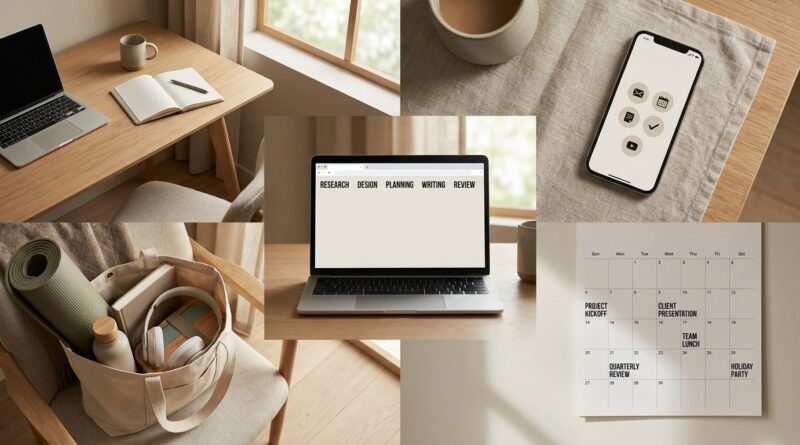
The 5-Object Rule is a simple reset. Pick five daily zones, your desk, your phone home screen, your browser, your bag, and your calendar. Then cap each one at five important things. Not perfect things. Important things. This is one of the most practical minimalist productivity pillars because you can do it fast, without buying anything, and feel the difference almost at once. Less visual noise. Fewer taps. Fewer decisions. More room to think.
⚡ In a Hurry? Key Takeaways
- The 5-Object Rule means limiting five daily areas, desk, phone, browser, bag, and calendar, to five essential items each.
- Start with your desk and phone first. Those two usually give the fastest boost in focus and calm.
- This is not about throwing away useful things. It is about cutting decision fatigue and reducing low-grade distraction.
Why clutter steals more focus than you think
Most clutter is not dramatic. It is not a garage packed to the ceiling. It is the extra mug on your desk. The seven browser tabs you swear you still need. The charger, receipt, and random cable in your bag. The meeting that did not need to happen. None of these feel huge on their own.
Put them together and they create friction everywhere.
Your brain has to keep scanning, sorting, ignoring, and deciding. That burns energy before you get to real work. If you have ever spent twenty minutes “getting ready” to start, you already know this feeling.
That is why the best minimalist productivity pillars are not fancy systems. They are limits. Clear, visible limits.
What the 5-Object Rule actually is
The rule is simple. In each of five daily zones, keep only five active things.
- Desk: Five visible items max
- Phone home screen: Five app icons max
- Browser: Five open tabs max
- Bag: Five everyday carry items max
- Calendar: Five must-do blocks or commitments per day max
This is not a law of nature. It is a useful cap. A speed bump for clutter. You are creating boundaries so your attention stops leaking out all over the place.
How to use the rule in under an hour
1. Desk: keep only what helps you do the next task
Look at your desk as if it belongs to someone else. What is actually needed for the next block of work?
For most people, the answer is something like this:
- Laptop or keyboard
- One notebook
- One pen
- Water or coffee
- One current reference item, maybe headphones or a document
Everything else is either storage or delay dressed up as preparation.
If you need more tools later, fine. Bring them in when needed, then remove them when done. The point is not to own less. The point is to see less while working.
2. Phone home screen: make distraction take one extra step
Your home screen should not be a vending machine for impulse. It should be a short list of tools.
Keep five apps on the first screen. Good examples:
- Phone
- Messages
- Calendar
- Maps
- Camera or Notes
Everything else can live in the app library, search, or one folder on the second screen.
This sounds small. It is not. If social apps and shopping apps are no longer waving at you every time you unlock the phone, your brain gets fewer chances to wander off.
3. Browser: five tabs or it is time to decide
Open tabs are the digital version of leaving every kitchen cupboard open. You can still cook like that, but it feels chaotic and wasteful.
Try this simple rule:
- One tab for the task you are doing
- One tab for communication
- One tab for calendar or project list
- Two spare tabs for research
If a tab is “important for later,” bookmark it, save it to read later, or add it to your task list. Do not make your browser hold your memory hostage.
If this idea clicks for you, you will probably also like How to Use the 5×1 Rule to Simplify Your Day and Finally Get Important Work Done. It makes the same point in a slightly different way. Fewer inputs often means better output.
4. Bag: carry your day, not your fears
Bags become portable junk drawers because they collect “just in case” items. Most of them never get used.
Pick your five everyday carry essentials. For example:
- Wallet
- Keys
- Phone charger
- Notebook
- Water bottle
Work gear for a specific day can be added on purpose. The difference matters. Purpose beats habit.
A lighter bag is not just nicer on your shoulder. It also removes that constant low-level rummaging, checking, and repacking that eats time.
5. Calendar: if everything is important, nothing is
This is where many people quietly sabotage themselves.
A packed calendar looks responsible. It can even feel productive. But if your whole day is spoken for, where does real work go? Where does thinking go? Where does recovery go?
Cap your day at five real commitments. That can include meetings, a focus block, an errand, a workout, or a family task. The key is that they must be meaningful and realistic.
When you limit the day, you stop pretending you have endless energy and infinite context-switching ability. You start planning like a human being.
What makes this work so well
The 5-Object Rule works because it cuts hidden decisions.
Every extra item in view asks a tiny question.
Should I read this?
Should I reply now?
Should I put this away?
Should I check that?
Should I bring this with me?
One question is nothing. Fifty is exhausting.
By using clear limits across these minimalist productivity pillars, you lower the number of choices your brain has to juggle. That frees up attention for work, conversations, ideas, and rest.
Common mistakes people make
Thinking this means owning almost nothing
It does not. Storage is separate from active space. You can still own tools, papers, and supplies. The rule only applies to what is currently visible, easy to tap, or scheduled for today.
Trying to clean everything at once
Start with two zones. Desk and phone are the easiest wins. Then do browser, bag, and calendar.
Making exceptions for every item
Of course there are edge cases. But if every item is special, the rule dies on day one. Be honest. Most clutter is not essential. It is just familiar.
Using folders as clutter hiding places
A folder full of twenty apps is still clutter. Hidden clutter is quieter, but it is still there. Keep the spirit of the rule, not just the letter.
A practical 45-minute reset
If you want to do this today, here is a simple plan.
- 10 minutes: Clear your desk to five visible items
- 10 minutes: Strip your phone home screen to five apps
- 5 minutes: Close browser tabs down to five
- 10 minutes: Empty and repack your bag with five essentials
- 10 minutes: Review tomorrow and reduce it to five true commitments
That is it. No color coding. No buying containers. No downloading a new “focus” app that becomes one more thing to maintain.
Who benefits most from this rule
This helps almost anyone, but it is especially useful if you:
- Work on a computer all day
- Feel overwhelmed by notifications and tabs
- Often lose things in your bag or on your desk
- Keep overbooking your days
- Love productivity systems but rarely feel calmer
If that sounds like you, the issue may not be discipline. It may just be too many open loops in too many places.
At a Glance: Comparison
| Feature/Aspect | Details | Verdict |
|---|---|---|
| Ease of setup | You can apply it to all five zones in under an hour with no special tools. | Excellent for busy people who want a fast reset. |
| Impact on focus | Cuts visual noise, reduces taps and clicks, and lowers decision fatigue throughout the day. | High impact, especially on workdays. |
| Long-term sustainability | Works best when treated as a weekly reset, not a one-time clean-up. | Very sustainable if you keep the limits simple and realistic. |
Conclusion
You do not need a complicated new system to feel more in control. You probably need fewer things competing for your eyes, fingers, and brain. People are drowning in micro clutter now. Too many tabs. Too many apps. Too many tiny decisions before they even start real work. A simple 5-object cap across the five daily pillars, desk, home screen, browser, bag, and calendar, gives you a concrete, doable reset you can finish in under an hour. Then you get to feel the benefit all week. Clearer focus. Calmer mornings. Less digital dopamine hijack. That is not minimalism for show. That is breathing room you can actually use.