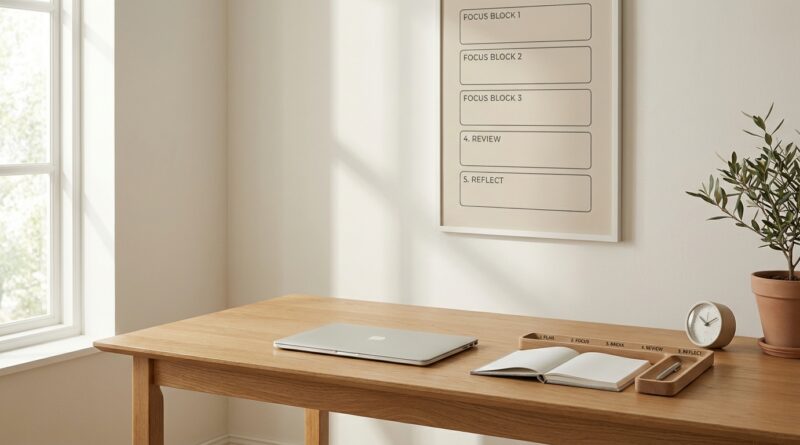
The 5‑Chunk Focus: A Minimalist Way To Finally Finish Deep Work In A Distracted Life
You sit down with a clear plan, open your laptop, and then the day slips away anyway. One message becomes three. One quick tab check turns into seven. By lunch, you have been busy for hours and still do not feel like you have actually finished anything that matters. That is frustrating, and it can start to feel weirdly personal, like you have lost the ability to focus. You have not. Most people are not failing at work because they are lazy. Their attention is simply being split too many ways at once. A minimalist deep work routine can help, but only if it is simple enough to use in real life. That is where the 5-Chunk Focus comes in. It gives your day five clear containers for attention, instead of asking your brain to juggle everything at once. Less sorting. Less switching. More finished work.
⚡ In a Hurry? Key Takeaways
- The 5-Chunk Focus is a minimalist deep work routine where you divide your day into five attention blocks instead of reacting to tasks nonstop.
- Match your hardest chunk to your best energy, silence distractions during that block, and keep admin tasks contained to lighter chunks.
- This is not about cramming more in. It is a calmer way to finish meaningful work without needing a full digital detox or burnout-inducing schedule.
What the 5-Chunk Focus actually is
The idea is simple. Your day gets five chunks of attention. Not fifty micro-decisions. Not an endless to-do list glaring at you from the corner of the screen.
Each chunk is a container for a type of work. Think of it like giving your brain five shelves instead of dumping everything in one messy drawer.
A chunk can be 30 minutes, 45 minutes, or 90 minutes depending on your job, your health, and your real life. The point is not the exact timing. The point is that you stop asking yourself what to do every ten minutes.
A basic example
Your five chunks might look like this:
- Chunk 1: Deep work on your most important project
- Chunk 2: Meetings or collaboration
- Chunk 3: Admin, email, messages
- Chunk 4: Second focused work block
- Chunk 5: Wrap-up, planning, loose ends
That is it. Five containers. The rest of the noise has fewer chances to creep in.
Why this works better than most productivity systems
A lot of productivity advice quietly assumes you have machine-like attention. You do not. Neither do I.
Real people get interrupted. Energy rises and drops. Some tasks need quiet. Others can survive a little chaos. The 5-Chunk Focus works because it respects that. It is structured, but not fussy.
It also cuts down on task switching, which is one of the fastest ways to feel busy and accomplish very little. Every time you bounce between writing, Slack, email, and planning, your brain pays a reset cost. You may only lose a minute here and there, but those minutes pile up.
If this sounds familiar, you might also like The 5-Slot Day: A Slow Productivity Routine For People Who Refuse To Burn Out For Their Job. It taps into the same truth. You are not broken. You are often just overloaded.
How to build your own minimalist deep work routine
1. Pick your five chunks before the day starts
Do this the night before if you can. Morning is fine too, but do it before the flood begins.
Name each chunk by purpose, not by every tiny task inside it. For example:
- Write proposal draft
- Team calls
- Inbox and approvals
- Analysis or design work
- Plan tomorrow and clean up
This keeps your brain from negotiating all day.
2. Match the chunks to your real energy
This part matters more than people think. Your best work should not be scheduled for the hour when you are tired, hungry, and half-listening to notifications.
If your mind is sharp in the morning, put your hardest chunk there. If you get a second wind later in the day, save a focus block for then. Put shallow work, like email or scheduling, into your lower-energy windows.
Do not build your routine for your ideal self. Build it for the version of you that actually shows up on a Tuesday.
3. Protect each chunk from distraction
A focus block without boundaries is just hope with a calendar invite.
Try this during your deep chunks:
- Put your phone in another room or at least out of reach
- Close every tab that is not needed for the task
- Pause chat notifications
- Use full-screen mode if it helps
- Keep a scrap note nearby for random thoughts so you do not chase them
You are not trying to become a monk. You are just making distraction slightly more annoying than staying on task.
4. Let admin stay in its lane
Email is not evil. Messages are not evil. But they expand to fill every gap if you let them.
One of the biggest benefits of the 5-Chunk Focus is that it gives admin work a place to live. Once inbox time has a home, it stops barging into every other room in your day.
If something is truly urgent, people will usually find a way to make that clear. Most of the time, what feels urgent is simply visible.
5. Stop at five
This is the minimalist part people want to skip.
Do not create nine chunks. Do not build a color-coded masterpiece that needs maintenance. Five is useful because it forces choices. You cannot pretend every task deserves prime attention. Some things will wait. That is not failure. That is prioritizing.
What to do when life blows up your plan
Some days are messy. A child gets sick. A client calls. A meeting runs long. Your brain feels like soup.
The 5-Chunk Focus is not ruined by that. It is actually more helpful on chaotic days because it gives you a way to reset fast.
If one chunk gets lost, do not rewrite your whole life at 2:17 p.m. Just ask:
- What chunk am I in now?
- What is the one job of this chunk?
- What can wait until the next container?
This keeps a rough day from turning into a fully scattered one.
Who this method is best for
This approach works especially well if you:
- Feel mentally pulled in six directions at once
- Do work that needs actual thinking, writing, design, coding, planning, or problem-solving
- Get overwhelmed by long to-do lists
- Want structure without turning your day into a military drill
- Are trying to build a calmer, more minimalist lifestyle
It is less about squeezing every drop of output from yourself and more about giving your attention a sane shape.
A realistic first-day version you can try this afternoon
If you want to test this without making it a whole project, use this simple setup:
- Chunk 1: 45 minutes on the single most important task
- Chunk 2: 30 minutes for communication
- Chunk 3: 45 minutes on the next meaningful task
- Chunk 4: 30 minutes for admin or errands
- Chunk 5: 15 minutes to review and set up tomorrow
That is enough to feel the difference.
Notice what happens when your day has edges. Notice how much lighter it feels when every interruption does not get equal voting rights.
At a Glance: Comparison
| Feature/Aspect | Details | Verdict |
|---|---|---|
| Structure | Five clear attention containers replace constant task switching and endless list checking. | Simple enough to stick with |
| Energy fit | You place deep work where your mind is strongest and move lighter tasks to lower-energy periods. | Much more realistic than rigid scheduling |
| Distraction control | Notifications, tabs, and inbox checks are contained instead of allowed to interrupt every task. | Best part for most overwhelmed people |
Conclusion
There is a reason so many people are suddenly drawn to digital detox retreats, softer spaces, and simpler routines. They are tired of feeling like their attention is being rented out by the minute. The good news is you do not need to disappear into the woods or rebuild your whole life to get some of that clarity back. A tiny rule like the 5-Chunk Focus can do a lot. You define five attention containers, match them to your real energy, protect them from distraction, and let the rest of the noise fall away. That is what makes this minimalist deep work routine so useful. It is small enough to try this afternoon, and solid enough to become part of a calmer, more modern minimalist lifestyle.